
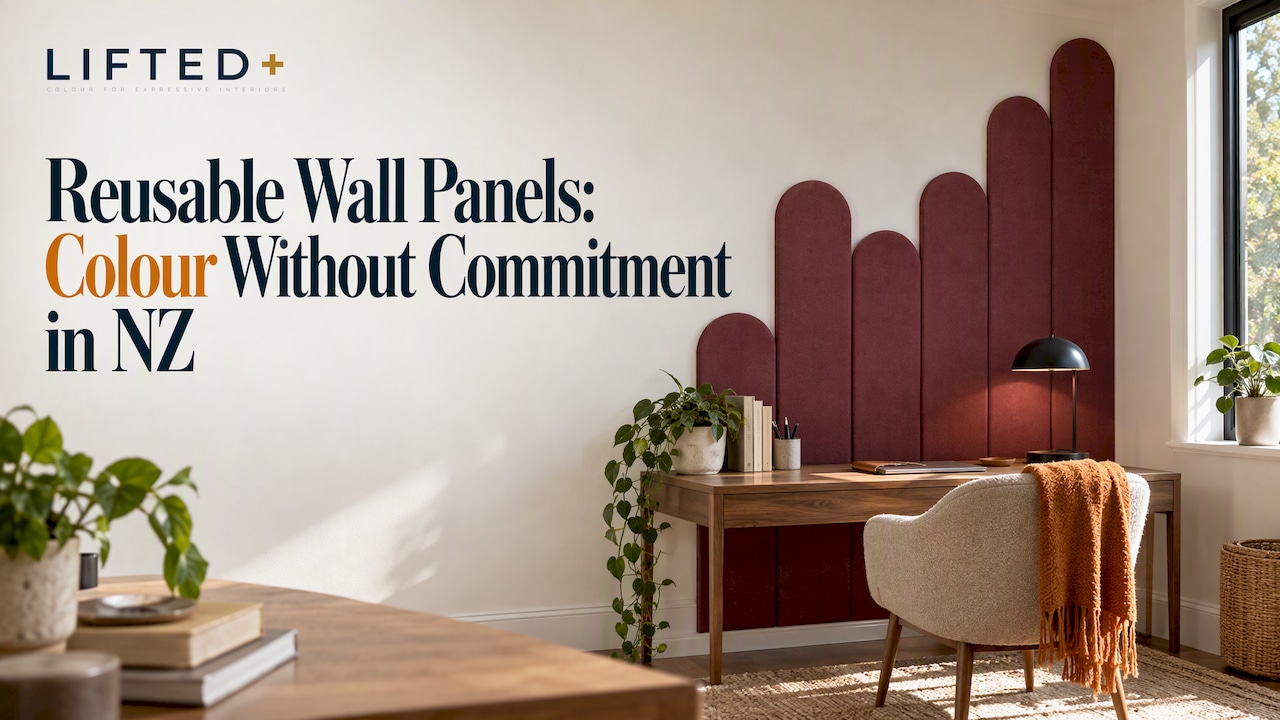
Reusable wall panels are lightweight decorative panels that go up without drilling, nails or paint, and come down again so you can rearrange them or take them to your next home. If you rent, move often or simply don’t want to commit a wall to one look for ten years, they are the practical answer to a blank, beige room. Below: what separates reusable panels from permanent panelling, how they attach, what to check in New Zealand before you start, and how to plan a wall that looks considered rather than stuck on.
Key takeaways
- Reusable wall panels are designed to be installed, lifted, rearranged and moved. Permanent panelling is fixed, filled and painted into the wall.
- No-drill does not mean no-risk. Wall finish, paint age and moisture all affect how any adhesive behaves, so test a small area first and never assume every wall suits every product.
- Renters in New Zealand need the landlord’s consent for changes, and should agree in writing what happens when they leave.
- Felt panels are light, textured and colourful. They suit bedrooms, hallways, living rooms and home offices, but not splash zones.
- Plan the layout on the floor first. Most disappointment comes from rushed placement, not from the panels.
Table of Contents
- The problem with a plain wall you can’t touch
- What reusable wall panels actually are
- Materials and formats you will meet
- How removable panels attach, and where they won’t
- Can you remove and reuse panels without damaging the wall?
- What to check before you install in New Zealand
- Planning a layout that looks designed
- Who reusable panels suit
- Beyond panels: other no-drill options
- Our perspective
- Thinking about recycled content and what happens later
- Where to start with DwellForms™
- Frequently asked questions
- Sources
The problem with a plain wall you can’t touch
You know the room. White or off-white, a little scuffed, a few suspicious patches where the previous tenant’s shelf used to be. You would love colour, but paint means permission, a weekend of masking tape and, in a rental, the prospect of repainting it back. Wallpaper is a bigger commitment still. Even a gallery wall means a row of holes.
So plain walls stay plain, and a home that should feel like yours reads like a holding pattern. That is the gap reusable panels fill: texture and shape on the wall, with a way back to the original surface.
What reusable wall panels actually are
The phrase covers a few different things, and it helps to separate them before you shop.
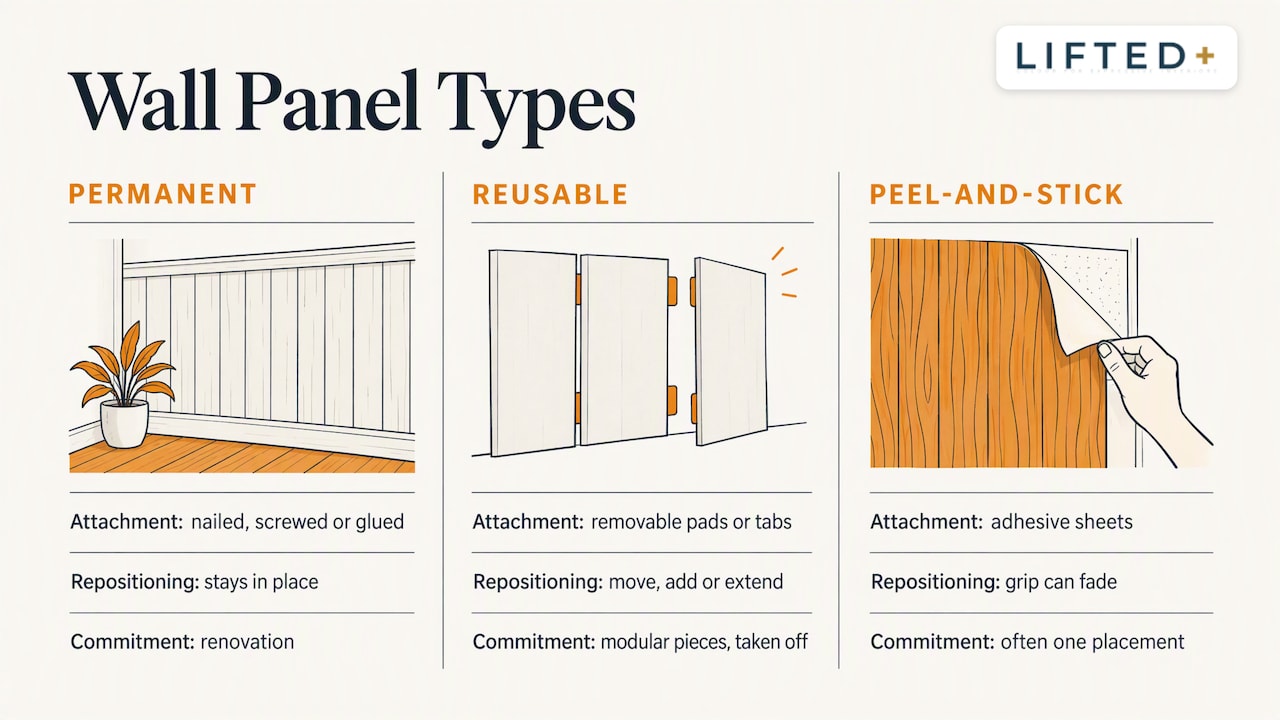
Permanent panelling is timber, MDF or composite that is nailed, screwed or glued to the wall, then filled and painted. It looks wonderful and it stays. It is a renovation.
Reusable wall panels are made to be taken off again. They are usually thin and light, they attach with removable adhesive, pads or tabs rather than fixings, and they come as modular pieces so a layout can be changed or extended.
Peel-and-stick sheets sit somewhere between. They are easy to apply, but the adhesive is often designed for one placement. Lift and re-stick, and the grip can fade.
The word that matters is modular. A reusable system is built from units you can reposition, add to, or pack flat. That is what lets a feature wall follow you from a flat in Newtown to a house in Hamilton without starting again.
Materials and formats you will meet
The panels ranking for this search in New Zealand show how wide the category is: timber slat panels, concrete-look panels, real stone composite sheets, fluted wood-look wallpaper panels and self-adhesive acoustic-style boards. They behave very differently.
| Type | Look | Weight | Reusability | Best for |
|---|---|---|---|---|
| Solid timber or MDF slat | Warm, architectural | Heavy | Low, usually fixed | Owners planning a permanent look |
| Stone or concrete composite | Rugged, tactile | Medium to heavy | Low to medium | Owners wanting a mineral finish |
| Peel-and-stick 3D sheets | Embossed, often white or wood-look | Light | Often single use | Quick, low-cost updates |
| PET felt panels | Soft, sculptural, colourful | Very light | Designed to be moved | Renters, movers, colour lovers |
None of these is wrong. A solid timber wall is a lovely thing in a home you own. But if the brief is take it with me, weight and adhesive type decide everything, and a light felt panel is simply easier to lift, store and rehang.
How removable panels attach, and where they won’t
There are three common routes.
Adhesive pads or tabs. Small pads sit on the back of the panel and press onto the wall. They carry the load across several points, so each pad does little work. This is the approach we use.
Pull-tab strips. The familiar strips with a tab you stretch to release. They work well for light frames, but we tested several tab and pad systems in developing DwellForms™ and deliberately discounted one popular brand, because the nano-adhesive pads we chose performed significantly better in our own testing at minimising damage to walls. That is our testing, not a promise: no adhesive is completely damage-proof.
Fixings. Screws, battens or construction adhesive. These are for permanent panelling, and they are the opposite of what a renter wants.
Whatever the attachment, the wall decides the outcome. As a general rule:
- Smooth, well-adhered, cured paint is the friendliest surface.
- Flaking, chalky or freshly painted walls are a poor base. Fresh paint needs time to cure first, so follow the paint maker’s guidance.
- Textured, damp, wallpapered or porous surfaces are unpredictable. Test, or choose another method.
- Bathrooms, laundries and kitchen splash zones are best left alone, and we don’t recommend felt panels there.
Before committing to a whole wall, press one pad or panel in an inconspicuous spot, leave it a few days, and see how it lifts. It takes five minutes and it tells you more than any product page.
Can you remove and reuse panels without damaging the wall?
Honestly: often yes, never guaranteed. Removal depends on the paint underneath, how long the panels have been up, temperature and humidity, and how carefully they come off. We don’t claim damage-free removal for any wall, and you shouldn’t trust anyone who does. What good design can do is spread the load across many small points of contact and make removal a slow, deliberate peel instead of a tug.
If you are weighing the bond question in detail, our guide on damage free wall panels for renters goes through the practical steps, and the piece on reusing wall panels without drilling covers moving them between homes.
What to check before you install in New Zealand
Rental consent
If you rent, start with your tenancy agreement. Tenancy Services states that tenants must get consent before making changes to the property, that landlords must not decline minor changes, and that tenants must remove installed fittings and restore the property unless the landlord agrees otherwise. Consent that follows the tenancy agreement, or is given in writing, cannot be unreasonably withheld.
In practice that means asking, not assuming. Send a short message with what you plan to install, how it attaches, and that you will remove it at the end of the tenancy. Keep the reply. If you want ideas for presenting a request, this roundup of renter friendly small space decor ideas shows how far temporary styling can go without touching the walls.
Fire and surface finishes
New Zealand’s Building Code requires interior surface finishes to resist the spread of fire and limit toxic gases, smoke and heat as appropriate to the building. The rules are written with whole buildings in mind, but the lesson for a buyer is simple: ask any supplier for product-specific fire information rather than relying on a general claim, especially for larger installations, apartments with shared egress, or homes you rent out.
Moisture and ventilation
The same regulations require protection against internal moisture, including fungal growth and moisture damage. Putting anything over a wall can change how that wall dries, so keep panels out of wet areas, leave the surface clean, and watch for condensation behind them over the first winter. If a wall already has mould or damp, fix that first. No panel is a solution to it.
Your own situation
Owners have fewer limits, but body corporate rules in apartment buildings may still apply to what you attach to shared or party walls. Check the rules before you buy.
Planning a layout that looks designed
The difference between a feature wall and a wall with things on it is hierarchy: one idea, clearly led.
Choose the wall that holds the room. Usually the one behind the bed, the sofa or the desk. One wall, done boldly, beats four walls done politely.
Decide your colour confidence level. If you tend towards neutral, choose one strong colour with two quieter companions. If you love colour, let a saturated shade carry the wall and keep the furniture calm. Ordering colour samples first lets you see shades in your own light, which in New Zealand can swing from crisp morning white to warm, low afternoon gold.
Lay it out on the floor. Arrange the panels on a clean floor, photograph the arrangement, then move two or three pieces and photograph again. You will usually prefer the second or third version.
Mark the centre line. Light pencil marks can be wiped later. A level, or a phone spirit-level app, saves a crooked wall.
Leave breathing room. Don’t run panels hard into corners, switches or skirting boards. A margin looks deliberate.
For pattern inspiration, our guides to colour-led modular panel patterns and geometric wall decor ideas show layouts you can copy and adapt.
Who reusable panels suit
Renters. The obvious fit: colour and texture with a plan for the day you leave.
Apartment dwellers. Light panels are easy to carry up in a lift, and a single bold wall gives a small open-plan room a focal point. See our picks of modular wall decor for apartments.
Home-office workers. A video-call backdrop with character beats a bare wall. Felt adds visual softness, though we don’t claim any acoustic result or suggest panels replace proper acoustic treatment.
Homeowners. Not ready to commit to permanent panelling? A removable wall lets you test a colour and shape for a year before deciding. The decorative wall panels guide for homeowners compares the routes.
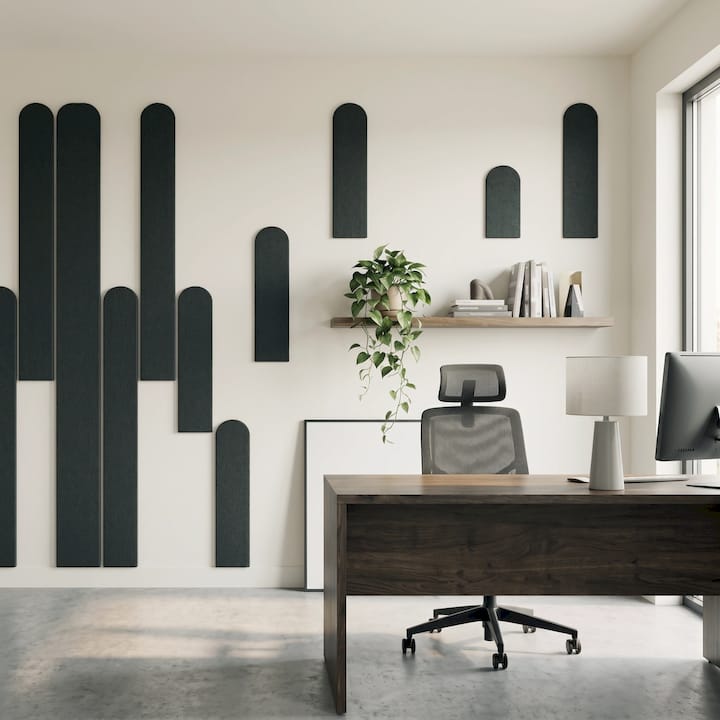
People in temporary or changing spaces. Flatshares, short leases, a house you’re about to sell or a place you’re only borrowing. A wall that packs flat suits a life that moves.
Beyond panels: other no-drill options
Panels are not the only way to change a wall without a drill, and a good room usually mixes several.
- Lean large art or a mirror on a console or the floor, and layer smaller pieces in front.
- Use a picture ledge with careful, agreed fixing, or a freestanding shelf as a gallery surface.
- Hang textiles from a tension rod in a window reveal or alcove.
- Add a statement lamp or large plant to pull the eye away from a blank corner.
- Protect the wall behind furniture to avoid scuffs, as covered in our guide on protecting walls behind furniture.
The no-drill wall decor ideas collection has more.
Our perspective
We started DwellForms™ from a simple irritation: so much good interior design assumes you own the walls. The neutral, temporary-feeling rental is almost a default, and we think that is a shame, because the place you spend your evenings should feel like it belongs to you from the first week.
We designed the panels in New Zealand around three beliefs. Colour should be allowed to lead. Texture and shape can do what flat paint can’t. And a wall treatment should survive a move. That is why the kits are modular PET felt, cut precisely, attached with tested adhesive pads, and made from recycled plastic.
We are also careful about what we say. We don’t promise that a panel will come off every wall without a trace, and we don’t present felt as soundproofing. What we can say is that we tested several attachment options, chose the one that performed best for us, and wrote guidance to help you test your own wall before you commit. A confident room starts with an honest set of expectations.
— Michelle
Thinking about recycled content and what happens later
Reusability is itself an environmental strategy. Research on circular construction describes designing for disassembly as prioritising components that can be easily retrieved and reused without losing functional value. A panel you can lift, store and rehang fits that thinking far better than one that is destroyed on removal.
When you see claims such as “recycled” or “recyclable” on any wall product, ask what share is recycled content, whether the maker can substantiate it, and what realistic options exist at end of life in New Zealand. Our explainer on what the recyclable label really means walks through the questions, and our page on recycled PET felt panels explains the material.
Where to start with DwellForms™
If you would like a renter-friendly feature wall that arrives as a kit rather than a project, our DwellForms™ Core Kits are the place to begin, with Extension Kits when you want the wall to grow. Not sure about the colour? Order samples first, and the sample purchase is credited towards a full kit order.
Frequently asked questions
Are reusable wall panels suitable for renters in NZ?
Often, yes, provided you have consent. Under Tenancy Services guidance, tenants need consent for changes, landlords must not decline minor ones, and fittings are removed at the end unless otherwise agreed. Get the agreement in writing before you install.
Can I reuse the panels in a new home?
That is what modular systems are designed for. Remove them slowly, keep the pads and packaging, and check the adhesive’s condition before rehanging. Your next wall’s paint and surface will affect how well they hold, so test again.
Will reusable panels damage my walls?
We can’t promise they won’t, and nobody honestly can. Risk depends on the paint, the surface, humidity and how long panels are left up. Testing a small area first and removing slowly are the best ways to reduce it.
Can I put them in a bathroom or kitchen?
We don’t recommend it. Moisture and splashes are a poor match for felt and for adhesive, and building rules treat moisture control seriously. Choose dry rooms such as bedrooms, hallways, living rooms and offices.
Do reusable panels soundproof a room?
No, and we don’t claim that they do. They add texture and colour. If noise is your main issue, look at dedicated acoustic solutions and speak to your landlord or building manager about options.
Sources
- Tenants making changes to the property, Tenancy Services
- Building Regulations 1992, New Zealand Legislation
- Designing for disassembly in circular construction, UCLouvain thesis
Recommended
- Reuse Wall Panels Without Drilling: NZ Renters Can Take Them Along
- Renters: Test Wall Panel Color Ideas For 3 Days Without Drilling
- No Paint Needed: 8 Renter-Friendly Color Palettes For NZ Rentals
- Removable Wall Panel Ideas For NZ Renters In 2026
This article is for general information and inspiration only. Product performance and results may vary depending on individual circumstances, surfaces and installation.
