

Last Updated: October 23, 2026
Quick Summary
Modern wall art for rental living means choosing artwork and wall décor that installs without drilling and removes cleanly at move-out. Match the fixing to the wall and the weight: adhesive strips suit light prints on smooth plasterboard, while picture rails, leaning and modular felt panels handle heavier or awkward walls.
- Adhesive strips hold light framed prints up to about 1.5 kg per pair on smooth painted plasterboard.
- Photograph every wall with a timestamp before hanging anything to protect your bond at move-out.
- Size art to roughly two-thirds of the furniture width below it, so a 2 m sofa wants 1.3 to 1.4 m.
- Keep 5 to 8 cm between gallery wall frames and hang the centre around 145 cm from the floor.
- Allocate about half your focal wall budget to artwork, a quarter to framing, and the rest to hardware.
Table of Contents
- Why Modern Wall Art Belongs in Every Rental
- Renter-Friendly Wall Decor That Respects the Lease
- How to Hang Pictures Without Nails: Methods by Wall and Weight
- Removable Wall Decor: Panels, Prints and Fabric Hangings
- Modern Living Room Wall Art: Building a Focal Wall
- Small Spaces, Budgets and Moving Day
- Frequently Asked Questions
Why Modern Wall Art Belongs in Every Rental
Modern wall art for rental living is the practice of personalising a rented home with artwork and wall décor that can be removed cleanly, moved between addresses and installed without drilling.
At Lifted Plus, we offer modular felt wall panels for renters who want colour and texture on their walls without a conversation with their property manager.
The good news is you no longer have to choose between a lease-safe wall and a wall you actually like.
Renter-Friendly Wall Decor That Respects the Lease
Renter-friendly wall décor is any wall treatment that can be installed and removed without permanent alteration to the wall surface. The test: if you moved out tomorrow, could you restore that wall to exactly how you found it?
Most standard tenancy agreements in this market require you to return the property in substantially the same condition, fair wear and tear aside. The Tenancy Services guidance on tenant responsibilities is the place to start, because the rules around minor changes and restoration differ from what most renters assume.
What to Check Before You Hang Anything
Run through this list before you buy a single hook:
- Does your agreement mention picture hooks, adhesive products or wall coverings by name?
- Is there a bond lodged, and what would a repair claim against it look like?
- What is the wall substrate: plasterboard, brick, concrete block, or something older?
Skip the photo record and you lose your best defence at move-out. Photograph every wall before you hang anything, with a timestamp. Damage disputes usually come down to what was there before you arrived, and without evidence the cost of repainting often lands on your bond.
How to Hang Pictures Without Nails: Methods by Wall and Weight
Hanging pictures without nails comes down to matching the fixing to two things: how heavy the piece is and what the wall is made of. Get that pairing wrong and the artwork ends up crooked, on the floor, or taking paint with it. The table is the short version; the notes underneath are where most renter mistakes happen.
| Method | Best for | Wall type | Weight limit guide | Removal behaviour |
|---|---|---|---|---|
| Adhesive strips | Lightweight framed prints, posters | Smooth painted plasterboard | Up to about 1.5 kg per pair | Pull tab stretches and releases; paint can lift if the wall was poorly primed |
| Adhesive hooks | Small canvases, lightweight mirrors | Smooth, clean, sealed surfaces | Up to about 2 kg | Clip releases; residue possible on low-sheen paint |
| Picture rail hooks | Anything up to medium weight | Walls with an existing picture rail | Depends on the rail and hook | Hook lifts off; no wall contact at all |
| Leaning on furniture | Large frames, oversized prints | Any wall | No limit, nothing on the wall | Nothing to remove; risk is falling, not fixing |
| Tension rod systems | Fabric hangings, lightweight panels | Between two walls or a recess | Light items only | Rod compresses out; check it cannot slip |
| Modular felt panels | Statement walls, colour blocks | Smooth and lightly textured walls | Per panel, per the maker’s spec | Panels lift away; adhesive tabs replaced cheaply |
The pattern: adhesives work brilliantly on smooth, sealed plasterboard and fail on textured or dusty surfaces. Anything heavier than a couple of kilos wants a rail, a lean, or a system designed to spread load.
Matching the Fixing to the Wall
Plasterboard is the most common interior wall lining in modern rentals and the most forgiving for adhesives, provided the paint is sound.
Brick, concrete block and older plaster-and-lath walls are a different story.
Textured and stippled finishes are where adhesive strips quietly give up: the strip needs continuous contact, and a rough finish means it only touches the high points.
Load, Spread and Failure Modes
Weight ratings assume a perfect bond on a clean, flat, sealed surface at room temperature.
Frames on a single hook pivot. Fine for a small print, but a wide frame on one central hook drifts out of level within weeks.
Angled walls and recesses are a different problem: a sloped ceiling line or chimney breast throws off every measurement from the floor.
Never hang a heavy mirror or large framed piece above a bed, a sofa or a child’s sleeping area using adhesives alone. If it falls, the fixing is not the expensive part. Use a rail, a lean against a wall the piece cannot topple from, or a floor-standing option.
Press adhesive strips for the full time on the packet, then wait before hanging. Most failures happen because someone stuck the strip on and hung the frame thirty seconds later. Give the adhesive time to bond and it will hold for years.
Removable Wall Decor: Panels, Prints and Fabric Hangings
Removable wall décor covers the spectrum from a single adhesive hook to a full modular panel system; the right choice depends on how much wall you want to change.
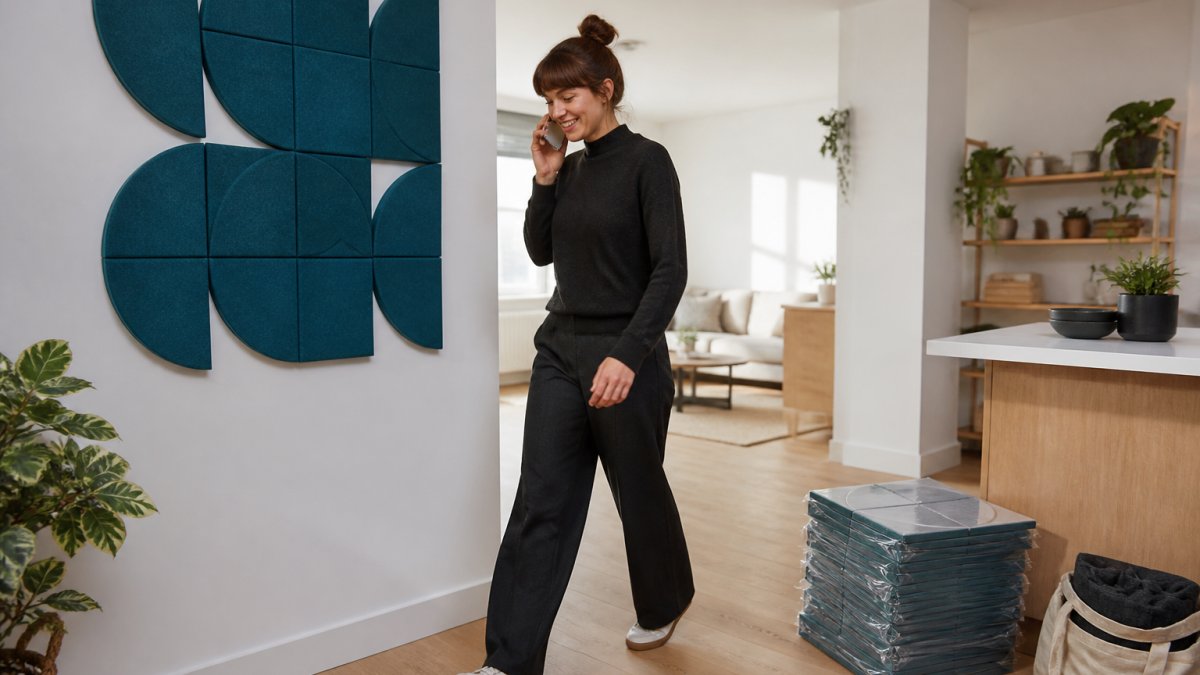
Canvas and framed art prints are the easy win: light, available in every size, and a well-chosen pair of large prints does more for a room than six small ones. Posters work the same way at lower cost, though they need framing to avoid looking like a student flat.
Fabric wall hangings soften a room in a way rigid frames cannot: they absorb sound, add texture, and roll up for moving day.
Then there is the category we build for. DwellForms™ wall kits are modular panels made from 100% recycled PET felt, designed to add colour, texture and architectural shape without paint or drilling.
Modern Living Room Wall Art: Building a Focal Wall
Modern living room wall art works best treated as one composition rather than a collection of separate pieces. Pick the wall you see first when you walk in, and give it everything.
Start with scale. A single large piece, or a grouped arrangement, should cover roughly two-thirds of the width of the furniture below it, a two-metre sofa wants artwork spanning around 1.3 to 1.4 metres.
Colour comes next. Pull two or three tones from what is already in the room, then add one that is not.
Scale, Colour and the Gallery Wall Layout
A gallery wall is just a focal wall with more pieces, and it lives or dies on the layout. Tape the arrangement on the floor first, or cut paper templates and stick them to the wall with removable tape. Step back, adjust, then commit.
- Keep gaps consistent: 5 to 8 cm between frames reads as deliberate
- Anchor the arrangement to a piece of furniture, not to the ceiling
- Mix sizes, but keep one dominant piece
One wall, done properly, beats five walls done halfway. Choose your focal wall, size the art to the furniture beneath it, and let the rest of the room stay calm.
Small Spaces, Budgets and Moving Day
Small rooms and tight budgets reward the same approach: fewer, larger, lighter. A studio or a small lounge does not need more stuff on the walls. It needs one strong moment and a restrained palette everywhere else.
Sizing Art for Awkward Walls
Standard sizing advice assumes a big blank rectangle. Rentals rarely give you one. Work from the furniture and the available wall, not from the room:
- Above a sofa or bed: aim for art spanning roughly two-thirds of the furniture width. A 2 m sofa wants about 1.3-1.4 m of artwork.
- Narrow strip beside a door: go vertical. A single tall piece or a stacked pair reads as intentional where a wide arrangement would look cramped.
- Above a desk or console: keep the bottom edge 15-20 cm above the surface so the piece relates to the furniture rather than floating.
A Realistic Budget Structure
Renters planning a cohesive wall usually spend across four lines, not one: artwork, frame, hanging hardware, and the cost of restoring the wall at move-out. The last line is the one people forget, and it decides whether a cheap option was actually cheap.
Set a total for the focal wall and allocate roughly half to artwork, a quarter to framing, and the rest to hardware plus a small contingency for touch-up paint.
Cheap prints are not the saving they look like if they need custom framing to look finished. Standard-size frames cost far less, so choose print sizes that fit off-the-shelf frames where you can.
Packing, Reuse and Storage Between Rentals
Moving day is where renter-friendly décor pays you back. Adhesive strips come off, frames go in a box, fabric rolls up, and modular panels stack flat. Nothing is nailed down, so nothing needs repairing, and reconfiguring in a new place takes an afternoon, not a weekend.
A few habits make the next move easier:
- Keep the original packaging for frames and panels if you have the space; it is designed for the shape.
- Wrap frames face-to-face with cardboard between them, and tape an X across the glass.
- Bag each piece of hardware with its label and keep it with the artwork it belongs to.
Label the back of each frame and each panel with where it hung in your last place. When you move, you will know instantly which pieces grouped well together, and you will rebuild a layout in minutes instead of starting from scratch.
Frequently Asked Questions
What kind of wall art is trending for living rooms right now?
Modern abstract compositions, muted landscape artwork and textured pieces lead right now, often grouped into a single focal wall rather than scattered across the room. Renters are leaning toward modular panels, canvas prints and fabric wall hangings because they can come down without filling holes. Tone-on-tone palettes with one bolder accent colour look current, and leaning framed prints on a sideboard is a simple way to get the look without touching the wall at all.
How can I hang wall art in a rental without damaging the walls?
Match the method to the wall and the weight. Adhesive strips suit lightweight artwork on smooth painted surfaces, picture hooks that use a single fine pin leave a mark no bigger than a pinhead, and modular felt panels or leaning frames avoid fixings entirely. Always clean the wall first, press adhesive strips firmly for the full recommended time, and test with a light pull before loading. Check your tenancy agreement before drilling anything, and patch and repaint before the final inspection.
Can removable wall decor be reused after moving?
Modular panels, canvas prints and fabric hangings can all move with you, which is why frequent movers favour them. Adhesive strips usually need replacing rather than reusing, so budget for fresh strips at each new place. Panels that clip or slot together can be reconfigured into a narrower or wider layout to suit a smaller room. Store pieces flat and wrapped rather than stacked under heavy boxes, and keep the original packaging if you have space for it.
How do I choose the right size wall art for a living room?
Measure the wall and the furniture below it. A common starting point is artwork spanning roughly two-thirds to three-quarters of the width of a sofa or sideboard, hung so the centre sits near eye level. On a large blank wall, a single oversized piece or a grouped arrangement fills the space better than several small frames. Cut paper templates and tape them up for a day before committing, especially for gallery wall layouts.
Renting should not mean living with bare walls and a deposit you are scared to touch. If you want a focal wall that goes up without a drill, comes down without a mark, and moves with you to the next place, explore DwellForms™. Our modular recycled PET felt panels add colour, texture and architectural shape to any room, and they are built to be reconfigured as often as you move. Get started with Lifted Plus and turn that blank wall into the best part of the room.

