

Bond friendly decor is any change to a rental that is reversible, low risk and documented, so the home can go back to the landlord in the condition you received it. In New Zealand that means two things working together: pieces that don’t need drills, paint or permanent fixing, and a clear paper trail that shows what you did and how you undid it. Get both right and a rental can look considered, colourful and entirely yours.
The word “friendly” matters. No product makes a wall immune to every risk, and we won’t pretend otherwise. What you can do is lower the odds, and decide with your eyes open.
Key takeaways
- Under NZ tenancy law you need your landlord’s consent before affixing fixtures or altering a rental, but a low-risk, easily reversible change may count as a minor change that a landlord can’t unreasonably refuse.
- Bond friendly is a design-and-process goal, not a guarantee: photograph the walls, ask in writing, test discreetly and remove slowly.
- Colour, texture, art and lighting can all be done without drilling or paint, so temporary never has to mean timid.
- Our DwellForms™ wall kits use tested nano-adhesive pads rather than screws or nails, but we never describe any adhesive as damage-proof.
Table of Contents
- What bond friendly really means in New Zealand
- What the law says about changing a rental
- Before you decorate: a process that protects your bond
- Surfaces that need a second look
- Colour without commitment
- Texture without renovation
- Art, mirrors and lighting that move with you
- Where a removable wall system fits
- Our perspective: why we chose nano-adhesive pads
- Taking it down: the move-out routine
- Start with colour, then build the wall
- FAQ
- Sources
What bond friendly really means in New Zealand
A general bond is money held against the condition of the home. Tenancy Services explains that it is usually refunded after the end-of-tenancy inspection when the property is in reasonable condition, has no damage beyond fair wear and tear, needs no repairs and has no money owing. The same guidance sets the maximum general bond at four weeks’ rent.
So the question is never “is this decor pretty?” but “will this leave a mark that I’m responsible for?” Fair wear and tear covers the slow ageing of a home that is lived in. A patch of lifted paint where something was stuck and pulled off carelessly does not sit comfortably in that category.
That is why we frame bond friendly as a risk question. A good choice is easy to reverse, light on the surface, and backed by a record that shows what the wall looked like before you began.
What the law says about changing a rental
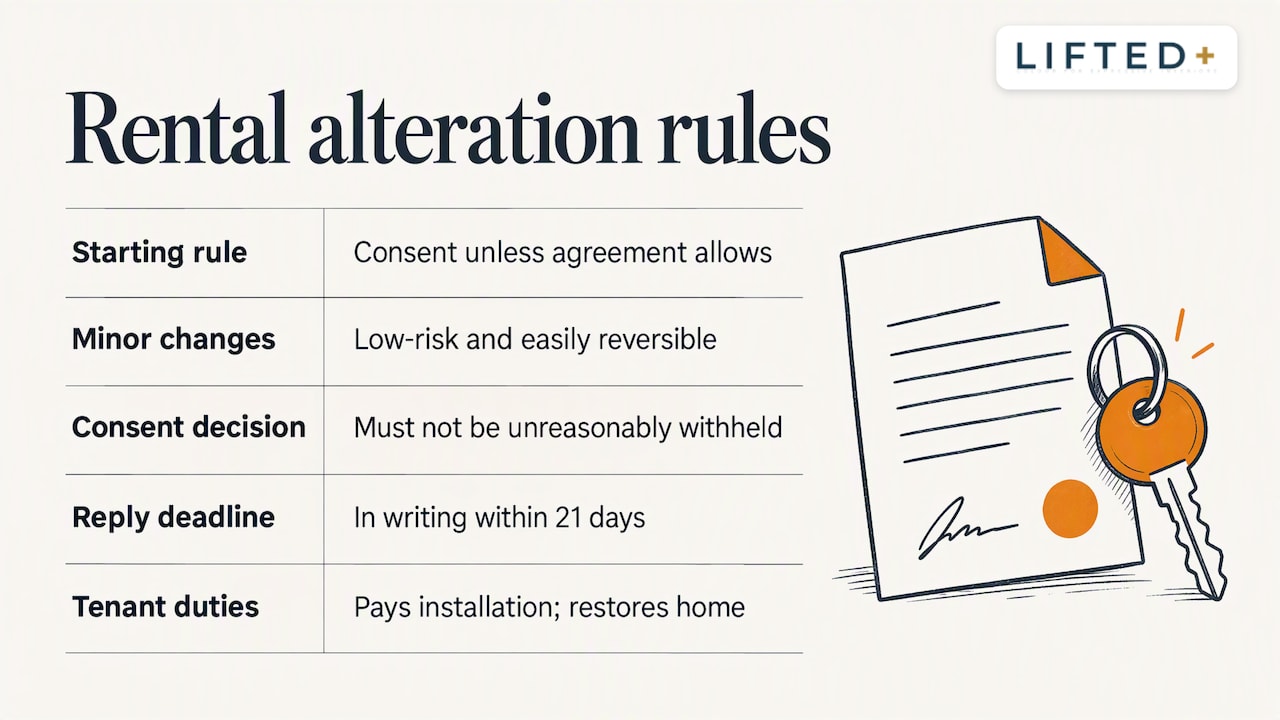
The starting point is section 42 of the Residential Tenancies Act 1986: a tenant must not affix a fixture or make an alteration unless the tenancy agreement allows it or the landlord gives consent.
Since the 2020 reforms there is a helpful middle path. The amended Act says a landlord must not unreasonably withhold consent for a fixture or alteration, and it singles out minor changes. Tenancy Services describes a minor change as low risk and easily reversible, and one that carries no health and safety risk, no structural or weathertightness impact, no interference with others and no breach of regulations. A landlord must reply in writing within 21 days.
Two details matter for decorators. First, the landlord may attach reasonable conditions. Second, the tenant normally pays installation costs and remains responsible for restoring the home. Consent opens the door; it doesn’t move the responsibility.
Living in an apartment or townhouse? Body corporate rules may form part of your tenancy agreement, so read them too, particularly if a change touches shared walls or the building’s appearance.
Before you decorate: a process that protects your bond
Experienced renters treat the paperwork as part of the design. Tenancy Services recommends a thorough inspection with the landlord at the start of a tenancy, a signed condition report, and a joint inspection before you leave. Here is the sequence we suggest.
- Read your tenancy agreement. Look for any clause on fixtures, nails, adhesives or alterations.
- Ask in writing. Describe the change plainly: what it is, where it goes, how it attaches and how it comes off. Tenancy Services publishes a response form for property change requests so you can see how landlords are expected to reply.
- Photograph the wall. Take wide and close shots, with a date, in good light. Include any existing scuffs, so nobody argues later about whose they were.
- Test somewhere discreet. Try your chosen adhesive on a hidden spot, such as behind a door or inside a wardrobe, and leave it for a few days.
- Follow the layout and weight guidance. A kit’s instructions exist because adhesives have limits.
- Keep the records. File the consent, the packaging and the instructions where you can find them in two years.
- Remove slowly and photograph it. Do this well before your final inspection, not the night before.
If something goes wrong, say so. Tenancy Services advises tenants to tell the landlord promptly and to discuss repairs before attempting them. It also separates fair wear and tear from careless or intentional damage, for which a tenant can be liable up to four weeks’ rent or the landlord’s insurance excess, whichever is lower, subject to the statutory conditions. Concealing a problem rarely helps.
Surfaces that need a second look
Not every wall behaves the same. Freshly painted walls, textured finishes, flaking paint, old wallpaper, damp-prone corners and some matte paints can all change how an adhesive releases. A bathroom wall and a bedroom wall are different propositions.
This is the reason for the discreet test in step four. If the test spot comes away with paint, or the surface feels chalky or loose, you have learned something valuable for the price of a small hidden patch. Stop, and choose a different approach for that wall: art leaned on a sideboard, a floor-standing mirror, or a textile on a rail that sits on existing hardware.
Colour without commitment
Renters are often handed a landlord’s choice of white or warm grey and told to live with it. We see that as a brief, not a verdict. Colour can arrive through objects as well as paint, and the strongest rental interiors do not confuse temporary with timid. Houzz NZ’s guide to stamping your style on a rental makes the same point with reversible touches.
A few principles hold across most homes.
Choose one anchor colour. A room that pulls itself out of the safe, polite middle usually does so with one confident hue, repeated in smaller doses. Our guide to colour palettes that need no paint walks through eight combinations built for NZ rentals, and mixing colours in interiors explains how to balance them.
Work in layers. A rug, curtains, cushions and a throw carry colour at different heights. The eye reads that as intention, not as a patchwork.
Let one wall lead. The wall behind a bed, a sofa or a desk is where colour and shape earn their place. Everything else can stay quiet around it.
Sample before you commit. Colour behaves differently under Auckland’s bright southern light than in a south-facing Dunedin flat. Put a swatch against the wall and look at it at morning, noon and evening before you decide.
For more ideas by room, see our roundups of rental friendly decor for NZ homes and flexible decor for renters.
Texture without renovation
Colour gets the attention, but texture is what makes a rental feel lived in rather than merely occupied. Woven baskets, a heavy linen curtain, a boucle chair and a chunky throw all add depth that a flat white wall can’t supply.
On the wall itself, texture is harder, because the usual routes (timber slats, plaster finishes, paint effects) are exactly what a landlord is likely to refuse. That gap is where lightweight, sculptural, removable surfaces come in. We cover the wider approach in how to add texture to a rental home.
Layout also shapes how a room feels, well beyond the walls. If you like to see how professionals think about flow and zoning, this look at kitchen layout trends from a North Carolina builder is an interesting read, even though your rental’s kitchen will stay exactly as it is.
Art, mirrors and lighting that move with you
Not everything needs to touch the wall. Large pieces leaned against a wall, on a shelf or on a sideboard look relaxed and architectural, and they leave no trace. A tall mirror propped at an angle bounces light across a dim room and doubles the sense of depth.
Lighting is the quiet hero. A floor lamp with a diffuse glow, or a plug-in lamp with a warm bulb, lifts a corner more than a ceiling fitting ever will, and it takes nothing from the building. Group lamps at different heights and the room gains a soft hierarchy of light.
If you want art with presence, our wall art collection and limited edition framed pieces suit leaning displays on a console or sideboard. For styling, wall art for modern NZ homes explains how mood and scale work together.
Where a removable wall system fits
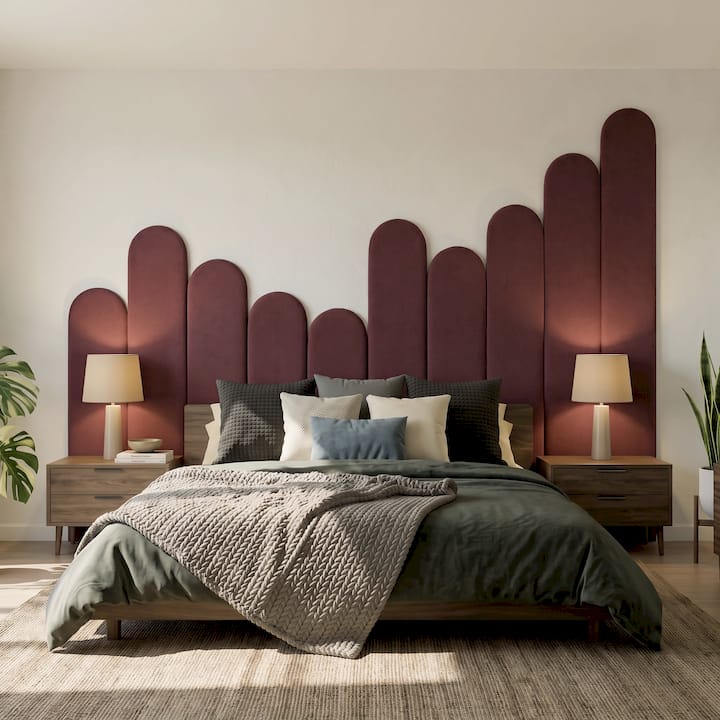
Sooner or later, most renters want the wall itself to do something. Paint is off the table, wallpaper is a gamble even in its removable form, and a gallery wall means holes. A modular, adhesive-mounted panel system is a different category: no drilling, no paint and no screws, and a layout you can lift, rearrange or pack for the next address.
That is what DwellForms™ by Lifted+ is designed to be. The panels are precision-cut PET felt made from 100% recycled plastic, supplied as kits with layout guidance. They create a renter-friendly feature wall in colour and sculptural shape, with texture that a flat surface lacks. Browse the DwellForms™ Skyline kit for a layered, skyline-like rhythm, or the Linear Feature kit for clean verticals.
A few honest limits apply. DwellForms™ is a decorative system, not soundproofing and not a commercial acoustic treatment. It does not suit every wall. And because any adhesive can interact with a wall’s paint and condition, we recommend the same discreet test and slow removal we described above.
Our step-by-step guide to protecting your bond with no-drill panels covers installation in more detail, and move-in wall ideas for NZ renters shows how to start strong in a new place.
Our perspective: why we chose nano-adhesive pads
We built DwellForms™ for people who want colour and shape on a wall they don’t own. That brief rules out the usual toolkit of screws, battens, nails and construction adhesive. The adhesive became the heart of the product, so we tested several options.
One popular pull-tab brand was among them. We deliberately discounted it, because the nano-adhesive pads we selected performed significantly better in our own testing at minimising damage to walls. That is our testing, on our panels, and it is not a promise about your wall. A newly painted surface, a textured finish or a damp corner can still behave differently, which is why we keep saying: test first, follow the layout and weight guidance, and remove slowly.
We also think the conversation about renting is too cautious. A home that looks borrowed tends to feel borrowed. Colour That Lifts is our way of saying that a lease should not decide how much of yourself you are allowed to put on the wall. The care should go into the process, so that bold and responsible sit in the same room.
— Michelle
Taking it down: the move-out routine
Removal is where bonds are won or lost, so give it the same attention as installation. Start at least a week before your final inspection, so there is time to deal with anything unexpected.
Work slowly and follow the removal directions that come with your kit. Rushing is the usual cause of lifted paint. Photograph the wall as each panel comes off, then again when it is bare. If you find a mark, tell your landlord or property manager and discuss it, which is what Tenancy Services recommends.
Then compare your photos with the condition report from move-in. If the wall matches, you have what you need for a smooth joint inspection. The panels, meanwhile, go into the box for the next home, and our guide to reusing wall panels without drilling shows how a layout can be adapted to a different wall.
Start with colour, then build the wall
If you’re not sure which shades suit your room, the Colour Samples range lets you hold the felt against your own wall in your own light, and sample purchases are credited towards a full kit order. When you’re ready, the DwellForms™ Core Kits give you a complete feature wall, and the Extension Kits let you grow the layout later.
FAQ
Do I need my landlord’s permission for removable wall decor?
Usually, yes, or at least it is wise to ask. Under the Residential Tenancies Act, tenants need consent before affixing a fixture or altering the property unless the tenancy agreement already allows it. A low-risk, easily reversed change may qualify as a minor change, and a landlord cannot unreasonably refuse it. Ask in writing and keep the reply.
Can adhesive decor really be damage-free?
No adhesive can honestly promise that. Results depend on the paint, the surface, the weight and how the product is removed. Our nano-adhesive pads performed best in our own testing at minimising wall damage, but we still recommend a discreet test and slow removal.
What happens if I damage the wall?
Tell your landlord promptly and talk through repairs before attempting them yourself. Tenancy Services separates fair wear and tear from careless damage, and for careless damage a tenant can be liable up to four weeks’ rent or the landlord’s insurance excess, whichever is lower, subject to the statutory conditions.
What is the easiest bond friendly upgrade for a renter?
Start with things that don’t touch the walls: a rug, lamps, curtains and leaning art. Then add one colour-led feature wall with removable panels once your landlord has agreed. This order builds personality quickly and keeps risk low.
Sources
- Tenants making changes to the property, Tenancy Services
- Refunding a general bond, Tenancy Services
- Damage and repairs, Tenancy Services
- Preventing problems with bonds, Tenancy Services
- Response to request to make a change to the property, Tenancy Services
- Residential Tenancies Act 1986, section 42
- Residential Tenancies Amendment Act 2020, sections 42A and 42B
- 8 ways to put your stamp on your pad, Houzz NZ
Recommended
- 21 Day Rule: How NZ Renters Add Colour Without Losing Their Bond
- Rental Friendly Decor NZ: 10 Ideas That Work
- NZ Renters: Colour Led Move In Walls That Protect Your Bond
- No Paint Needed: 8 Renter-Friendly Color Palettes For NZ Rentals
This article is for general information and inspiration only. Product performance and results may vary depending on individual circumstances, surfaces and installation.
