
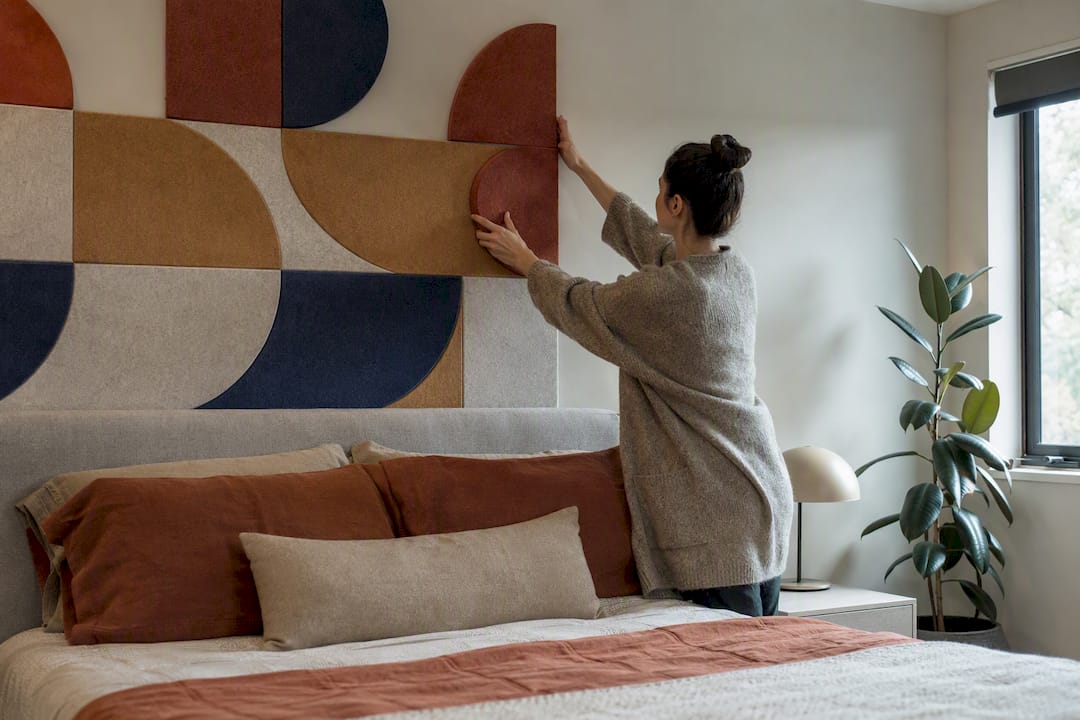
The best bedroom statement wall ideas fall into five reliable camps: paint geometry, peel-and-stick wallpaper, wood slats or paneling, textured or fluted panels, and removable modular panels. Each one solves a different problem, and picking the wrong one for your situation is how you end up repainting in six months.
If you rent, the safest bets are peel-and-stick wallpaper and removable modular panels. Both go up without drilling and come down without an argument with your landlord. If you own the place and don’t mind a weekend of prep, paint geometry, slat walls, and fluted panels open up more permanent texture and depth.
- Paint geometry — cheapest, most flexible, best for owners willing to tape and edge carefully (covered in Section 2)
- Peel-and-stick wallpaper — fast, pattern-rich, fully renter-friendly (Section 2 and 5)
- Wood slats or paneling — architectural impact, better suited to owners or long-term renters (Section 2 and 4)
- Textured or fluted panels — depth and shadow play, works for both owned and rented walls depending on the kit (Section 4)
- Removable modular panels — colour and texture with zero wall damage risk, the strongest all-round choice for renters (Section 5)
Key Takeaways
The most reliable bedroom statement wall combines the right material for your lease and skill level with restraint everywhere else in the room.
| Point | Details |
|---|---|
| Match material to tenancy | Renters do best with peel-and-stick wallpaper or removable modular panels; owners have more freedom with paint and slats. |
| Treat the bed wall first | The wall behind the bed anchors the room and is the strongest default choice for a statement treatment. |
| Test before committing | Live with a paint swatch or sample panel for at least a day under different light before covering the whole wall. |
| Limit to one feature | Keep bold pattern or colour to a single wall to avoid the room reading as cluttered or tacky. |
| Choose removable panels for zero-risk texture | DwellForms™ modular PET felt panels use adhesive pads only, giving renters and homeowners colour and texture without drilling or paint. |
Table of Contents
- Bedroom statement wall ideas grouped by material and mood
- How to choose the right statement wall for your bedroom
- Materials, tools, and the mistakes worth avoiding
- Renter-friendly, no-drill panels: what actually happens on the wall
- Styling the room so the wall doesn’t stand alone
- Measuring, prepping, and budgeting for your project
- Why the flat accent wall is losing ground
- Start your statement wall with DwellForms™
- Sources
- FAQ
Bedroom statement wall ideas grouped by material and mood
Once you know which category suits your lease and your patience level, the next decision is which specific look to chase. Here’s how each material behaves in a real bedroom, not a showroom.
1. Paint techniques that do the heavy lifting
An arched headboard shape painted directly onto the wall behind the bed gives you a soft, sculptural focal point without touching a saw. Two-tone walls (colour block from the skirting up to shoulder height) add drama in small rooms where a full-height dark wall would feel oppressive. Geometric tape lines are the cheapest way to fake a designer edge, though they demand patience with a spirit level. For genuine mood, a moody single wall in deep charcoal or ink blue works especially well when the rest of the room stays pale.
2. Wallpaper and murals for pattern without permanence
Peel-and-stick wallpaper is the standard renter-friendly route into pattern, and it removes far more cleanly than pasted paper, which is why designers commonly recommend it for rentals. Because a single accent wall usually needs only one to three rolls versus eight to twelve for a full room, it’s one of the lowest-commitment ways to try a bold mural. Scale matters here: oversized botanical or landscape prints suit large walls, while smaller bedrooms read better with a tighter, more graphic repeat.
3. Wood and slat solutions for architectural rhythm
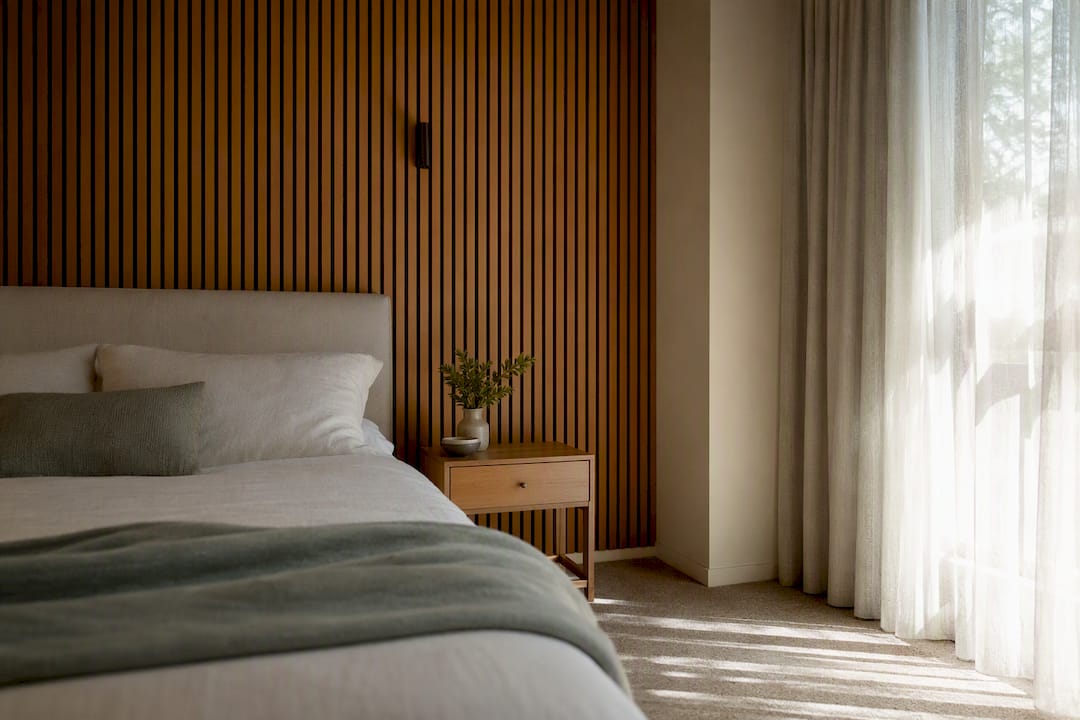
Vertical slat walls draw the eye upward, which is exactly why they’re so often used to make a low bedroom ceiling feel taller, and many now come as prefinished kits designed for a weekend install. Shiplap and board-and-batten sit in the same family but read more traditional. If you’re renting long-term and want this look without fixings, a slat-style removable panel kit gets you the visual rhythm without the commitment.
4. Textured and fluted panels
Fluted or ribbed panel walls change how light falls across the room throughout the day, throwing soft vertical shadows that a flat painted wall can’t produce. This layered, tactile approach is increasingly favoured over the flat single-colour accent wall, which can start to feel dated next to more textured, architectural treatments.
5. Fabric, upholstered walls, and canopy treatments
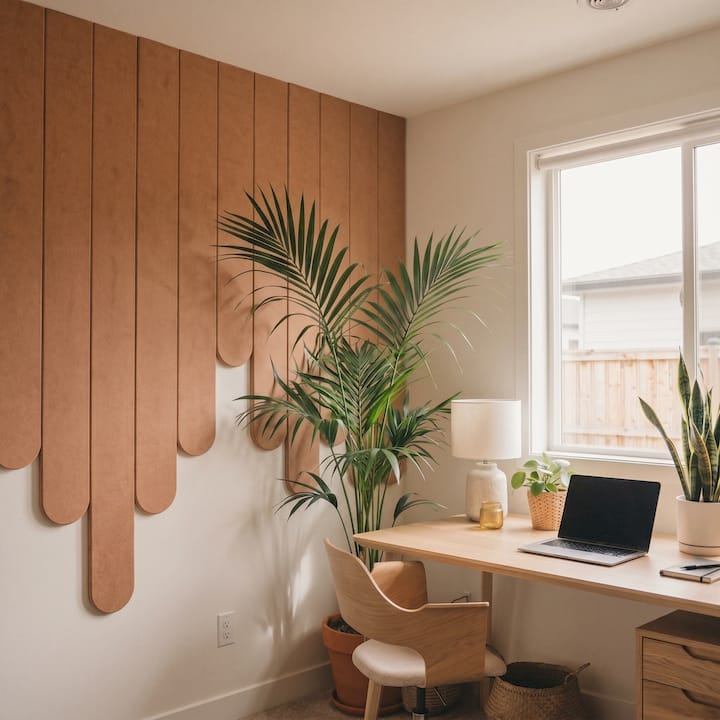
An upholstered headboard wall or a hung fabric canopy softens a bedroom in a way hard materials can’t, and both are essentially furniture rather than renovation, which makes them naturally lease-friendly.
6. Mixed materials and quick accents
Layering a plaster or paint base with slats mounted over the top, or boxing wallpaper inside painted moulding, is what gives a wall that expensive, considered look, because layered materials read as more architectural than a single finish ever can. If you want something faster, a tight gallery wall, a warm LED strip run along a shelf edge, or a single sculptural light fitting can carry a statement-wall effect with almost no structural work at all.
Pro Tip: Pick your mood before your material. Decide whether you want the wall to feel cocooning, energising, or calm, then choose the colour or texture that serves that feeling rather than picking a finish first and hoping the mood follows.
How to choose the right statement wall for your bedroom
Design pros consistently point to the wall behind the bed as the natural anchor for a statement treatment, since it frames the sleep zone and is the first thing you see on entry. The main exception is a bedroom where the door faces a strong architectural feature, like a window bay or a fireplace wall, in which case that wall often wins instead.
Before you commit to a material, run through this:
- Live with a sample for at least a day in different light. Designers recommend testing a two-foot swatch rather than trusting a paint chip under shop lighting.
- Match pattern scale to wall size. Large-format prints suit generous walls; tight repeats suit small or broken-up ones.
- Confirm landlord permission where required, even for adhesive products, before you buy materials.
Timeline and budget snapshot: paint is typically a weekend job start to finish, wallpaper a single day once walls are prepped, a slat kit a weekend, and removable modular panels can go up the same afternoon you unbox them.
Materials, tools, and the mistakes worth avoiding
1. Paint: Prime first, especially over a dark existing colour, and swatch generously before you buy. Sharp tape lines need burnished edges and a slow peel while the paint is still slightly tacky, not fully dry.
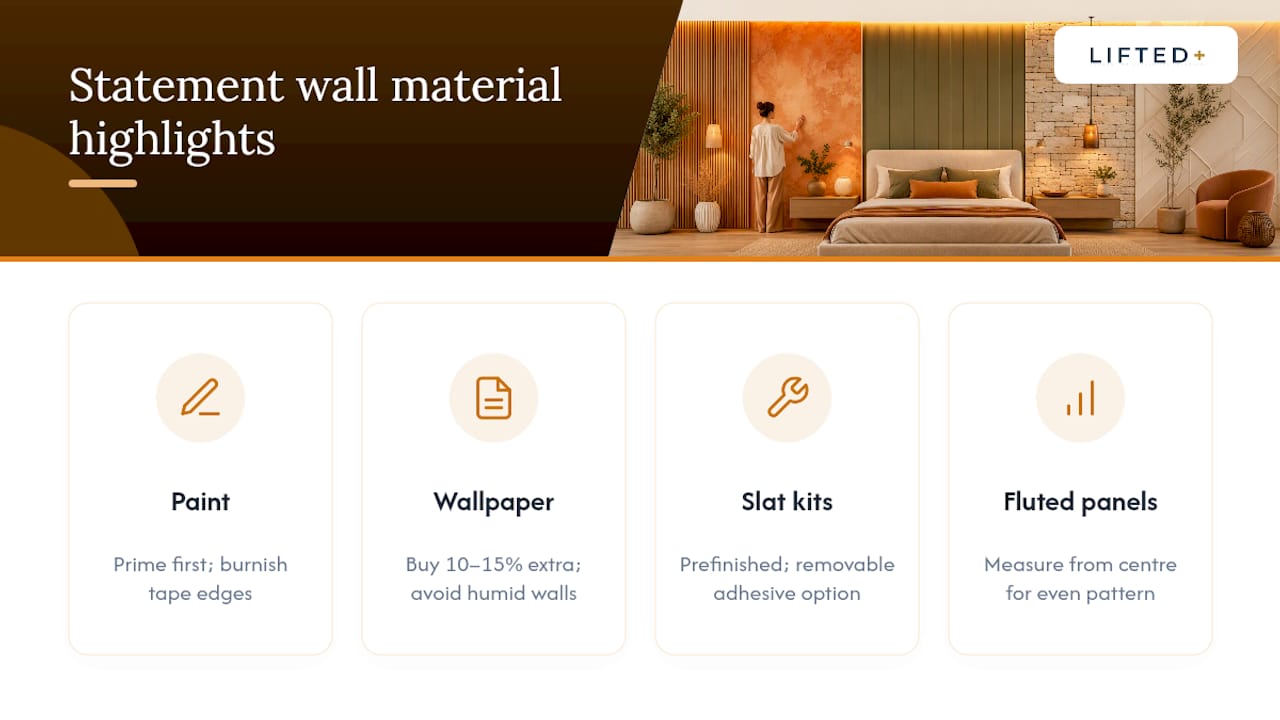
2. Wallpaper: Peel-and-stick suits most rentals; pasted paper suits permanent installs and pattern-heavy repeats. Always buy 10 to 15% extra for pattern matching and offcuts, and avoid humid bathrooms adjoining the bedroom wall.
3. Wood and slat kits: Most kits arrive pre-cut and prefinished. Traditional fixing methods use battens and screws, but for renters, a removable, adhesive-mounted panel kit delivers the same slatted look with none of the wall damage.
4. Textured and fluted panels: MDF fluted panels need careful measuring from the centre of the wall outward so the pattern lands evenly at both edges, not from one corner.
5. Common errors: Skipping the sample test, ignoring humidity near ensuites, and treating more than one wall as a “feature” are the three mistakes that turn a good idea into a messy result.
Renter-friendly, no-drill panels: what actually happens on the wall
Modular panels made from PET felt give you colour and three-dimensional texture without a single hole in the wall, which is exactly why non-permanent, textured solutions are increasingly preferred for rentals. Liftedplus builds this into DwellForms™: modular kits arrive in a range of colours and layouts, with a sample kit whose cost is credited toward a full order if you decide to commit, plus layout guides and styling support so you’re not left guessing at spacing.
Installation runs on tested adhesive pads rather than screws or construction adhesive, which is what makes the whole system genuinely removable wall design rather than a permanent fixture in disguise.
- Clean the wall thoroughly and let it dry before applying any panel; adhesive pads need 24 to 48 hours to cure properly for the best hold.
- Heavily textured plaster or flaking paint will affect adhesion, so stabilise the surface first rather than assuming every wall will take a panel equally well.
- Repositioning is realistic within limits, but this isn’t a guaranteed damage-free product on every wall type; check your specific surface first.
Pro Tip: Choose removable panels over paint or wallpaper when you want texture and colour without commitment, particularly if you expect to move within a year or two, or if your lease restricts wall alterations outright.
Styling the room so the wall doesn’t stand alone
A statement wall only works if the rest of the room supports it rather than competes with it. Designers advise limiting bold treatment to one wall, then echoing its colour in smaller doses elsewhere, a cushion, a throw, a lampshade, rather than matching it exactly.
- Use sconces or directional spotlights to rake light across textured or fluted surfaces and bring out the shadow lines.
- A warm LED strip behind a headboard or along a shelf edge adds glow without competing with the wall’s own colour.
- Anchor the wall visually with symmetrical bedside lamps or a pair of floating shelves either side of a single oversized piece of wall art.
- Don’t add a second “feature” wall in the same room, and don’t hang more than one large pattern near the statement wall. That’s the fastest route to a room that reads as tacky rather than considered.
Measuring, prepping, and budgeting for your project
Start with the wall itself: measure width and height at three points, since older homes rarely have perfectly square walls, and use the narrowest measurement when ordering paint or panels to avoid running short.
For paint, budget roughly a full weekend, one day to prime and cut in, one to apply two coats and remove tape. Wallpaper is faster once the wall is clean and dry, often a single day for an average bedroom wall, though pattern matching on a large mural adds time. Slat kits and fluted panel kits typically run a full weekend if you’re building from individual pieces, but pre-assembled sections cut that down considerably.
Materials lists differ by approach, but the essentials are consistent: a spirit level, painter’s tape, a tape measure, sample pots or swatches, and, for panel-based approaches, a clean dry cloth for surface prep.
The biggest budget variable isn’t the material itself, it’s whether you need to fix underlying wall issues first. Cracked plaster, flaking paint, or old picture-hook holes all need attention before wallpaper, paint, or adhesive panels will sit properly, and skipping that step is the single most common reason a statement wall looks unfinished within a year.
Why the flat accent wall is losing ground
Most advice on statement walls still treats colour as decoration, something you add once the “real” design decisions are made. That’s backwards. Colour sets the atmosphere of a bedroom before anything else does, and treating it as an afterthought is why so many accent walls feel bolted on rather than designed in.
The conventional advice to “just paint one wall a bold colour” isn’t wrong, but it’s incomplete. A flat single colour was the default for a decade, and it can still work, but it’s increasingly the least interesting option on the table next to textured, layered, or modular treatments that add actual depth to the wall’s surface. Renters have historically been told to make do with removable decals or the occasional peel-and-stick roll. That undersells what’s now possible.
What should you prioritise first? Not the colour, the constraint. Work out whether you’re renting, how long you’re likely to stay, and whether you want to take the look with you when you move. That single question determines whether paint, wallpaper, or a modular panel system is the right starting point, and skipping it is why so many people repaint a wall they only lived with for a year.
— Michelle
Start your statement wall with DwellForms™
If you’ve read this far and landed on removable modular panels as your best fit, DwellForms™ is built for exactly that decision. It gives you sculptural, coloured texture on a bedroom wall using tested adhesive pads only, no drilling, no paint, no permanent change; this makes it the practical middle ground between a flat rental wall and a full renovation you can’t take with you.
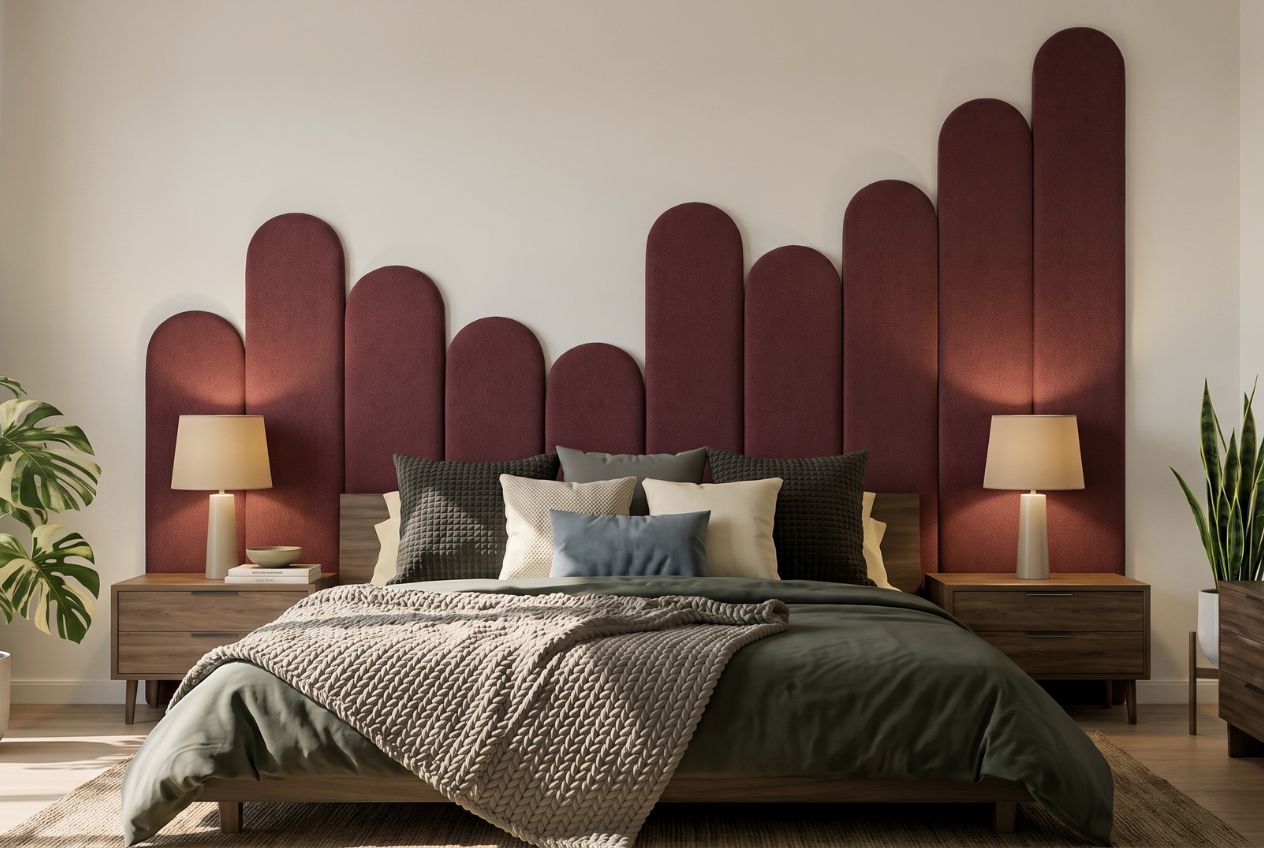
It suits renters who need their bond back, apartment dwellers working with strict landlord limits, and style-first homeowners who simply want colour and texture up faster than a weekend of taping and painting allows. Panels rearrange and can move with you if you relocate, so the wall you create today can be reused later.
Start with the DwellForms™ Skyline modular wall panel kit if you want a bold sculptural repeat behind the bed, or browse the Linear Feature kit for a more streamlined, architectural look. Every kit ships with layout guides, and a sample kit purchase credits toward your full order if you decide to commit. If you’re still narrowing down your exact colour and layout, the removable wall panel guide for renters is a useful place to plan your wall before you buy.
Sources
- Bedroom Accent Wall Ideas: Paint, Wallpaper, Paneling, and Trim Options
- 32 Bedroom Accent Wall Ideas That Make a Statement
- 30 Stunning Bedroom Accent Wall Ideas That Deliver a High-End Designer Look
FAQ
What are some good bedroom accent wall ideas for 2026?
Textured and fluted panels, moody single-colour walls in deep blues or earthy tones, and modular removable panels are leading directions, alongside peel-and-stick murals for renters wanting pattern without commitment.
What makes a bedroom look tacky?
Treating more than one wall as a “feature,” clashing multiple bold patterns in the same room, and skipping surface prep before painting or papering are the most common causes of a cluttered, unfinished-looking result.
What are the bedroom trends for 2026?
Textured architectural details like fluted panels and slat walls are gaining ground over flat single-colour accent walls, paired with nature-led palettes such as sage, terracotta, and deep blue.
What are some unique bedroom wall ideas beyond paint?
Upholstered headboard walls, fabric canopies, mixed-material layering (slats over a painted base), and modular panel systems like DwellForms™ all deliver texture and shape without a paintbrush or a drill.