

TL;DR:
- Many non-paint feature wall ideas offer renter-friendly, removable options like textiles, decals, and acoustic panels. Proper surface testing and environmental considerations are essential for successful installation and maintenance. Layering lighting and decor transforms these surfaces into impactful design elements within any living space.
You want a feature wall that genuinely holds a room. But painting feels too permanent, too messy, or simply off the table if you’re renting. The good news is that feature wall ideas without paint have come a long way beyond peel-and-stick borders and sticky decals. Today’s options range from tactile wood installations to sculptural acoustic panels, each capable of transforming a flat surface into something with real presence. This guide walks you through the criteria that matter, the best methods available, and exactly how to match them to your space.
Table of Contents
- Key takeaways
- What to consider before choosing feature wall ideas without paint
- 1. Peel-and-stick wallpaper
- 2. Wall decals and large-format prints
- 3. Tapestries and textile hangings
- 4. Timber accent strips and wood panels
- 5. Acoustic fabric panels
- 6. Removable tile and vinyl cladding
- 7. Freestanding and leaning installations
- 8. Stretch canvas and framed art groupings
- 9. Comparison of non-paint feature wall options
- Matching the right method to your situation
- My honest take on non-paint feature walls
- Bring your feature wall to life with Liftedplus
- FAQ
Key takeaways
| Point | Details |
|---|---|
| Test before committing | Always patch test adhesive products on your wall surface for several weeks before full installation. |
| Renter-friendly first | Removable and adhesive-mounted options protect your bond and avoid drill holes on most surfaces. |
| Surface condition matters | Weak or flaking paint bonds increase the risk of damage even with gentle adhesives. |
| Layering adds depth | Combining textiles, art, and lighting makes a non-paint feature wall feel intentional and complete. |
| Match method to room | Humidity, room use, and wall type should guide your choice as much as aesthetics do. |
What to consider before choosing feature wall ideas without paint
Not every wall treatment works on every wall. The surface you are working with shapes your options more than most guides admit. Plasterboard, smooth plaster, textured render, and older painted surfaces each behave differently under adhesive products. Weak paint bonds increase the risk of surface damage even when the adhesive itself is designed for gentle removal.
Think carefully about the room’s function before choosing a method. Bathrooms and kitchens introduce moisture and steam, which can compromise edge adhesion on peel-and-stick products and warp lightweight timber panels. Living rooms and bedrooms are far more forgiving. Humidity is the silent enemy of many otherwise excellent no paint wall ideas.
Consider your installation approach honestly. Some options require only your hands and fifteen minutes. Others, like a DIY timber accent wall, demand cutting, sanding, and measured application. If you are renting, lean towards methods that use stretch-to-release or low-tack adhesives and avoid anything that requires drilling.
Pro Tip: Before committing to any adhesive product on a rental wall, press a small strip of the adhesive into an inconspicuous corner and leave it for two to three weeks. Remove it slowly at a low angle. If paint lifts, choose a different product or method entirely.
Maintenance also deserves consideration upfront. Textured surfaces trap dust. Fabric panels require occasional vacuuming. Timber strips need wiping. The most beautiful feature wall loses its appeal quickly if it becomes a cleaning burden. Choose something you will actually maintain.
1. Peel-and-stick wallpaper
Peel-and-stick removable wallpaper is one of the most popular non-paint wall designs available right now, and with good reason. The pattern range is extraordinary: linen textures, geometric prints, botanical illustrations, and even faux marble finishes are all accessible at a reasonable cost. Installation on a single feature wall typically takes under an hour and requires no specialist tools.
The risk, however, is real. Experts recommend patch testing for several weeks before full installation to check removal performance on your specific wall. Older paint surfaces and high-humidity rooms are the most vulnerable. Peel-and-stick wallpaper is best suited to smooth, well-primed surfaces in dry rooms.
One detail most people overlook: adhesives harden over time, making removal progressively more difficult. If you install peel-and-stick wallpaper in a rental property, plan for removal well before your lease ends rather than scrambling at the last minute.
2. Wall decals and large-format prints
Decals occupy a slightly different niche from wallpaper. Rather than covering an entire wall, they create focal points: a single oversized botanical, a repeating geometric border, or a typographic statement. The adhesive footprint is smaller, which means lower removal risk. They are particularly effective as apartment wall art ideas where you want visual impact without covering every square centimetre.
Large-format removable prints have also matured as a category. Some products now mimic canvas texture convincingly. The key is choosing designs with real compositional weight rather than novelty graphics that date quickly.
3. Tapestries and textile hangings
A well-chosen tapestry does something paint rarely achieves on its own: it introduces texture, softness, and acoustic warmth simultaneously. Hung using a timber dowel and two small adhesive hooks, a large textile can cover an entire wall without a single drill hole. This is one of the most genuinely renter-friendly DIY feature wall options available.
Woven wool tapestries, printed canvas hangings, and macramé panels each create a distinct mood. For a considered, contemporary look, choosing wall art with a grounded colour palette rather than trend-led prints gives the piece longevity. The installation is reversible, the styling is flexible, and the visual impact is immediate.
4. Timber accent strips and wood panels
Timber accent walls are among the most visually striking creative wall treatments you can create without paint. Using furring strips adhered in a staggered, brick-like pattern, you can build a surface with genuine tactile interest. Material costs can be as low as $45 for a full wall, making this one of the more budget-conscious options.

The honest caveat is labour. Cutting, sanding, and precisely placing each strip takes time and patience. Pre-rounded furring strips reduce the sanding burden significantly if you can source them. The result, though, holds a room in a way that printed wallpaper rarely does. The depth and shadow created by layered timber strips are architectural in character.
This method works best for homeowners rather than renters, given the adhesive commitment involved. If you do choose it as a renter, discuss the installation with your landlord beforehand and document everything in writing.
5. Acoustic fabric panels
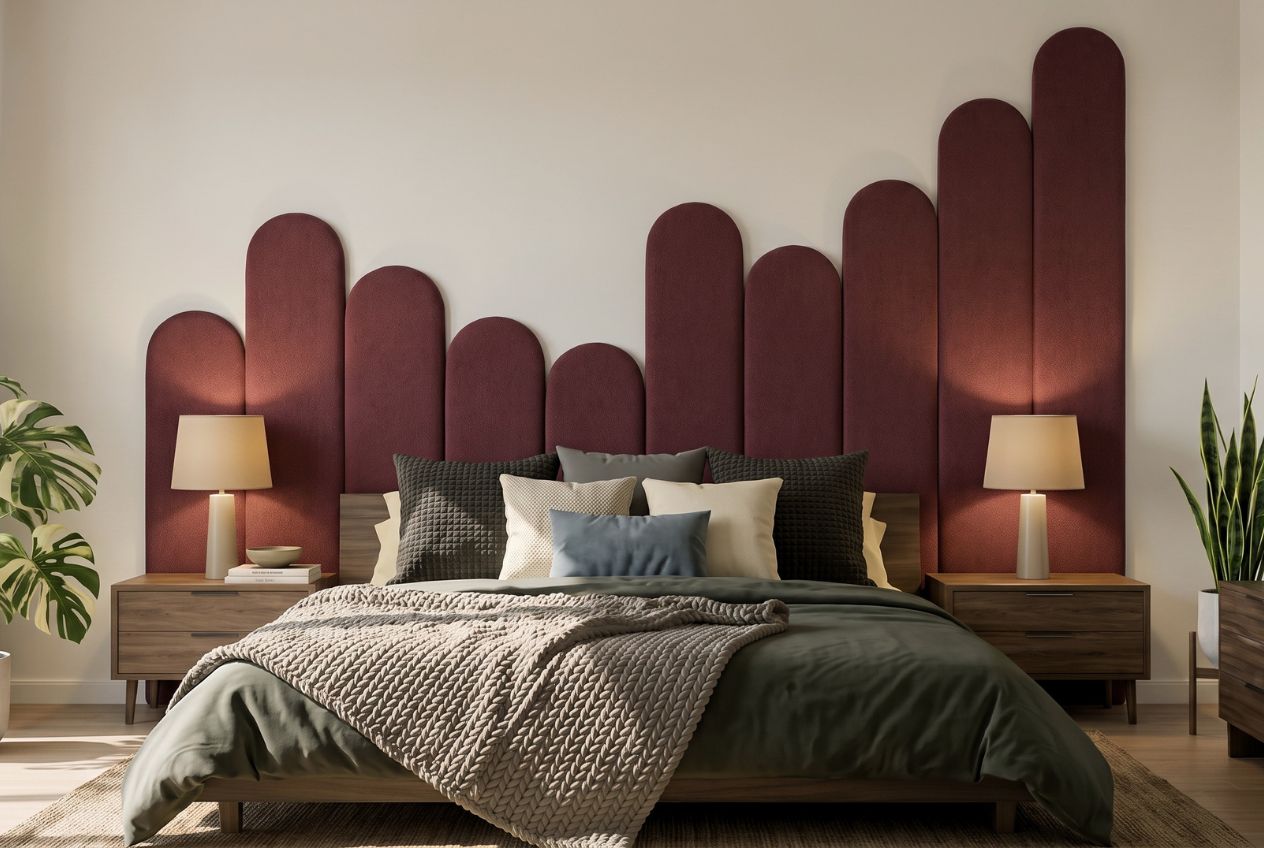
Acoustic panels have crossed over from recording studios and offices into residential interiors, and it is easy to see why. They absorb sound, soften hard surfaces visually, and can be upholstered in almost any fabric you choose, from natural linen to deep-toned velvet. As a feature wall treatment, they create a grid-like composition with real sculptural presence.
The installation method is where these panels shine for renters. An 8-panel accent wall can be installed in under 90 minutes using adhesive-only mounting, with no drilling required. Applying adhesive in an S-pattern over 60 to 70 percent of the panel’s back surface provides the strongest bond on plasterboard, textured wallpaper, and smooth plaster. Removal is clean and leaves no holes.
Pro Tip: For the strongest adhesive-only mount on acoustic panels, use an S-pattern application across 60 to 70 percent of the panel back rather than applying adhesive in dots or a perimeter line.
6. Removable tile and vinyl cladding
Peel-and-stick tiles and vinyl cladding panels have improved significantly in quality and realism. Subway tile profiles, slate textures, and even timber-look vinyl planks are now available in formats designed for wall application without permanent adhesive. These work particularly well in kitchen splash-back areas and bathroom feature walls, though careful moisture control during cleaning remains critical to prevent edge lifting.
Vinyl cladding panels clip or press-fit together in some formats, eliminating adhesive entirely. These are worth considering where you need a fully removable solution with no residue risk at all.
7. Freestanding and leaning installations
Not every feature wall needs to be attached to the wall at all. A tall, slim bookcase pushed flush against a surface creates visual structure and allows you to layer objects, art, and plants in a way that a flat treatment cannot. A folding screen, a leaning artwork, or a floor-to-ceiling grid of stretched canvases achieves the same spatial anchoring without a single adhesive involved.
This approach works well in spaces where the wall surface is genuinely off-limits, whether due to strict lease conditions or a wall finish that cannot tolerate any adhesive. The visual weight of a well-composed freestanding arrangement can equal that of any painted or papered treatment. For more unconventional approaches, gallery wall alternatives offer good reference points for thinking beyond the traditional.
8. Stretch canvas and framed art groupings
A deliberate grouping of framed art or large stretched canvases is one of the most versatile wall decor ideas available. The key is scale and spacing. A single large canvas anchors a wall. A grouping of three to five frames in related tones creates rhythm. The difference between a feature wall and a random collection of pictures comes down to intentional composition.
For renters, picture hooks with removable adhesive pads are widely available and rated for frames up to several kilograms. The stretch-to-release technology now used in premium adhesive hooks makes clean removal far more reliable than older foam-pad products.
9. Comparison of non-paint feature wall options
Choosing between these options is easier with a clear side-by-side view. The table below summarises the most relevant decision-making factors for each method.
| Method | Cost | Installation ease | Damage risk | Renter-friendly | Humidity suitability |
|---|---|---|---|---|---|
| Peel-and-stick wallpaper | Low to moderate | Easy | Moderate | Conditional | Low |
| Wall decals | Low | Very easy | Low | Yes | Moderate |
| Tapestry/textile | Low to moderate | Very easy | Very low | Yes | Moderate |
| Timber accent strips | Low material cost | Moderate to hard | Moderate to high | Not recommended | Low |
| Acoustic fabric panels | Moderate | Easy | Very low | Yes | Moderate |
| Removable tile/vinyl | Moderate | Easy to moderate | Low | Yes | Moderate to high |
| Freestanding/leaning | Variable | Very easy | None | Yes | High |
| Framed art groupings | Variable | Easy | Very low | Yes | Moderate |
The freestanding and textile options carry the lowest damage risk across the board and suit almost any living situation. Timber accent walls offer the greatest visual impact but carry the most commitment. For humid spaces, removable tile or vinyl cladding with proper moisture management is the strongest choice.
Matching the right method to your situation
Your living situation should guide your shortlist before aesthetics enter the conversation. Renters on strict leases should prioritise options that leave no trace: tapestries, freestanding installations, acoustic panels with adhesive mounting, and stretch-release picture hooks cover almost every stylistic intention without putting a rental bond at risk.
Homeowners with permanent residency can afford to consider timber accent walls and more involved panel installations. The investment in labour and material pays off over years rather than months. When you own the wall, you can also think about layering methods: timber strips paired with carefully positioned sconces or integrated shelving turns a feature wall into something closer to an architectural gesture.
For humid areas, choose moisture-tolerant materials from the start. Removable vinyl cladding with sealed edges performs well in kitchens. A tapestry is not suited to a bathroom. Matching material to environment is not optional if you want the installation to last.
Cleaning deserves equal attention. Use barely damp, non-abrasive cloths on peel-and-stick surfaces and dry them immediately. Acoustic panels benefit from a light vacuum every few weeks. Timber strips can be wiped with a dry microfibre cloth in most cases.
Pro Tip: Layering your feature wall with a complementary light source, whether a wall sconce, a floor lamp angled toward the surface, or an LED strip behind a panel, transforms the texture into shadow and depth. It shifts the wall from background to foreground without changing the installation at all.
For a more thorough introduction to how accent walls function in NZ interiors, the accent walls guide from Liftedplus covers the strategic thinking behind choosing which wall to treat and why.
My honest take on non-paint feature walls
I’ve worked with enough clients on this question to have a strong opinion: most people underestimate the wall and overestimate the product. I’ve seen beautiful peel-and-stick wallpaper pull entire patches of paint off surfaces that looked perfectly sound. I’ve also seen a $45 timber strip wall transform a rental lounge into something a design magazine would photograph. The material is only half the answer.
What I’ve learned is that preparation is where the result is actually decided. Test your wall. Check the paint bond. Clean the surface before anything goes on it. These steps feel tedious and most people skip them. But a feature wall that fails at removal is genuinely distressing when your bond is on the line.
I’d also push back on the idea that non-paint automatically means less. Some of the most considered rooms I’ve seen use acoustic panels in a deep, warm fabric paired with a single large canvas and a directional floor lamp. The wall holds the room. It has weight and shadow and warmth that flat paint cannot replicate.
Experiment within your constraints rather than being paralysed by them. A tapestry hung with two adhesive hooks is not a compromise. It is a choice. And it can be a genuinely excellent one.
— Michelle
Bring your feature wall to life with Liftedplus
A feature wall without paint does not stop at the installation itself. The art, objects, and lighting you place in relation to it are what give it full presence. At Liftedplus, we curate wall art for NZ homes that is chosen for visual weight, colour resonance, and the way each piece holds space on a wall. Whether you are working with acoustic panels, a textile backdrop, or a bare wall waiting for the right piece, our range gives you the final layer that completes the composition. Explore our modern home decor to find pieces that feel genuinely considered rather than decorative by default.
FAQ
Can I create a feature wall without damaging rental walls?
Yes. Tapestries hung with adhesive hooks, freestanding installations, and adhesive-mounted acoustic panels are all suitable for rental properties and leave no lasting damage when removed correctly.
How long do peel-and-stick products last on walls?
Most peel-and-stick wallpaper holds well for one to three years on smooth, dry surfaces. Extended dwell time increases residue risk, so plan removal before your lease ends rather than waiting until moving day.
What is the cheapest DIY feature wall option without paint?
A tapestry or textile hanging is typically the lowest-cost option. For a more architectural result, DIY timber strip walls can be achieved for around $45 in materials, though the labour investment is significant.
Are acoustic panels suitable for residential feature walls?
Absolutely. Adhesive-mounted acoustic panels install without drilling, hold securely on plasterboard and smooth plaster, and can be upholstered in residential fabrics to suit any interior aesthetic.
How do I clean non-paint feature wall surfaces?
Use a barely damp, non-abrasive cloth on peel-and-stick surfaces and dry them immediately to prevent edge lifting. Fabric and acoustic panels are best vacuumed lightly with a soft brush attachment every few weeks.
Recommended
- 9 Fresh Alternatives To A Gallery Wall – Lifted+ | More Colour. More Mood. More Life.
- 11 Apartment Wall Art Ideas For NZ Homes – Lifted+ | More Colour. More Mood. More Life.
- 11 Statement Wall Art Ideas For Modern Homes – Lifted+ | More Colour. More Mood. More Life.
- How To Create An Art Wall: Step-by-step Guide