
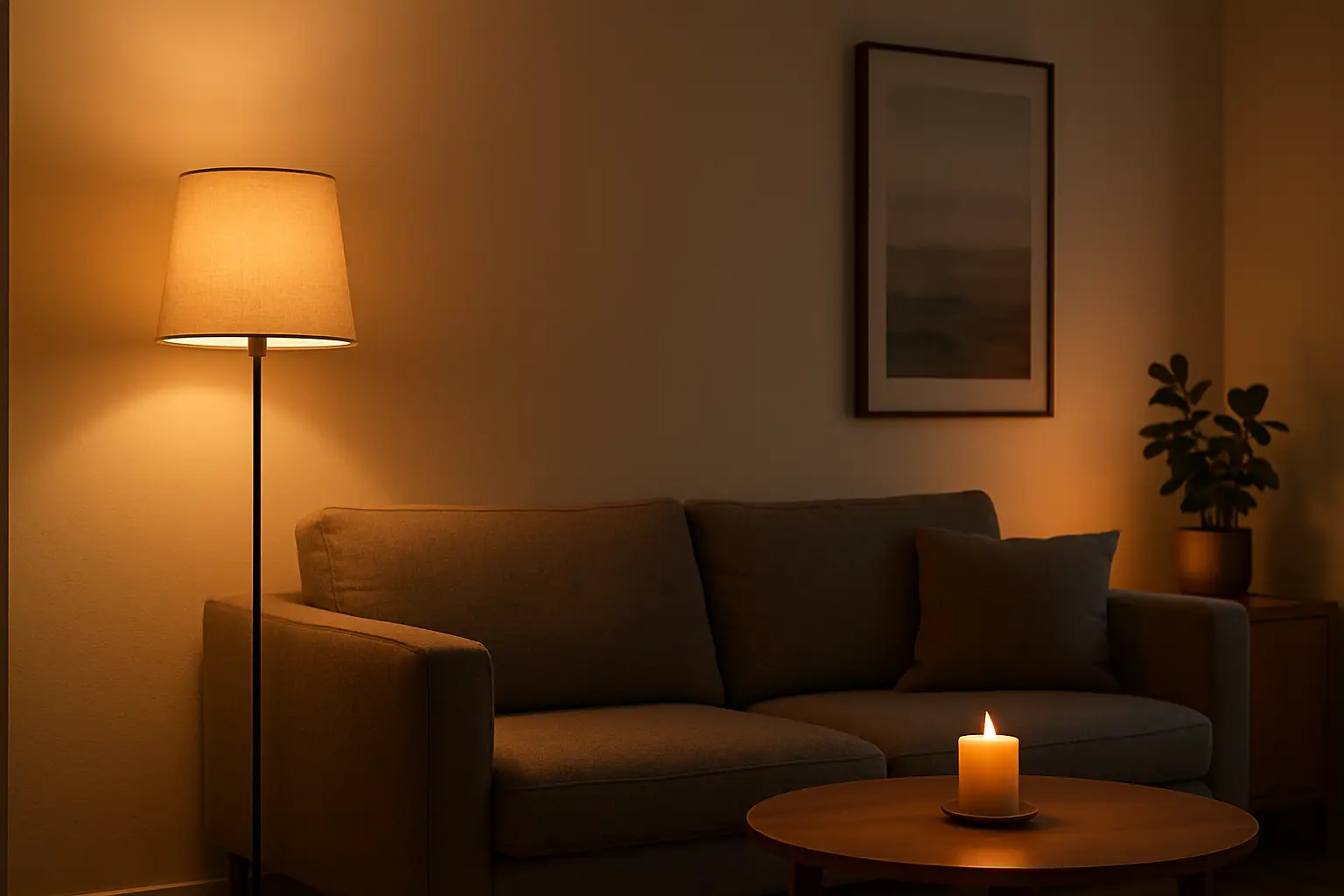
You know that moment when a room looks fine in daylight, then absolutely falls apart at night. The overhead light flattens everything, your art disappears into the wall, and suddenly your carefully chosen palette reads… beige. Mood lighting fixes that, but not with a single “warm bulb” and a prayer.
A mood lighting scheme is a deliberate composition. It’s light placed at different heights, aimed with intent, and tuned so the room feels like you meant it. It can be calm, cinematic, electric, intimate, or energising. The point is choice – not whatever the ceiling fitting decides for you.
Table of Contents
What “mood lighting” really means (and why it’s not just dimmers)
Mood lighting is the emotional layer of an interior. It’s the difference between a space that’s technically bright enough and a space that feels alive. Most homes rely on one central source, usually a downlight grid or a pendant. That approach is efficient, but it’s also brutal – shadows are harsh, faces look tired, and the room has no depth.
A mood lighting scheme works because it layers three types of light: ambient (the overall glow), task (where you need clarity), and accent (where you want drama). The scheme comes to life when those layers are balanced, not when everything is “warm” by default.
There’s a trade-off: mood lighting is rarely the cheapest route, and it asks you to commit to placement. But it repays you every evening, especially in winter, when the lights in your home do more heavy lifting than your décor.
How to create a mood lighting scheme: start with the feeling
Before you buy anything, decide what the room should do to your nervous system.
In a living room, you might want low, lateral light that makes conversation feel easy and keeps the corners softly present. In a dining space, you might want a pool of light that makes food look good and turns the rest of the room into a backdrop. In a bedroom, you want the opposite of “alert”.
A useful test is this: if you turned off all the lights except two, which two would you keep on for an hour? The answer tells you what kind of mood you actually want, not what you think you should want.
Now look at the room’s hero. It might be a piece of architectural-scale art, a sculptural chair, a textured wall, or a view. Mood lighting works best when it serves a focal point. Otherwise, you’re just brightening objects at random.
Layer the light, not the fittings
The quickest way to upgrade the mood is to stop thinking in terms of “a lamp” and start thinking in terms of “a height”. Ceiling light, eye-level light, and low-level light each hit the room differently.
Ceiling light is for arriving home, cleaning, finding things, and the occasional Friday night that turns into a kitchen debrief. It should not be your default setting. If you have downlights, put them on a separate circuit if you can. If you’re renting or not renovating, you can still create separation by simply not using them, then building your own layers.
Eye-level light is where mood lives. Wall lights, pendants that sit lower, or table lamps on sideboards create flattering shadows and give objects dimension. This is the level where art and colour start to look intentional.
Low-level light is the secret weapon. Floor lamps, low table lamps, even light spilling from a hallway can make a room feel expensive because it creates depth. Low light also makes colour richer. Bold tones look more saturated and more confident when they’re not being interrogated from above.
If you’re stuck with one ceiling pendant, don’t panic. The scheme can still work, but you’ll need to counterbalance it with at least two additional sources at different heights.
Get serious about colour temperature (warm is not one thing)
People talk about “warm light” like it’s a single setting. It isn’t. Colour temperature is a spectrum, and small changes matter.
For most homes, 2700K is a safe starting point for evening mood – warm enough to feel flattering, not so amber that whites turn yellow. 3000K is slightly crisper and can work beautifully in kitchens or contemporary spaces where you want energy without that clinical office feel. Go cooler than that at night and you’ll start fighting your own circadian rhythm.
The tricky part is consistency. A room with mixed colour temperatures feels unsettled, like you can’t relax because your eyes keep adjusting. If you’re mixing brands or replacing bulbs over time, check the Kelvin rating and keep it aligned within a space.
Also, pay attention to colour rendering, often listed as CRI. If you care about art, textiles, and paint, low CRI lighting will dull them. High CRI keeps reds warm, blues clean, and skin tones human.
Aim light like a stylist, not a spotlight operator
Mood isn’t only about brightness. It’s about direction.
If your lighting points straight down, the room becomes a series of harsh cones. Better: bounce light off walls, graze texture, and let shadows exist. Shadows are not the enemy – they’re what give the room shape.
Try lighting your vertical surfaces, not just the floor. A lit wall makes a room feel larger and calmer because your eyes see an even field rather than a dark boundary. This is also how you make a statement artwork hold a room at night. A controlled wash of light makes the piece feel like architecture, not decoration.
Be careful with exposed bulbs and clear shades if you want mood. Glare kills atmosphere. If you can see the filament directly from the sofa, the scheme will always feel a bit tense. Diffused shades, indirect light, and careful placement win every time.
Use dimming, but don’t outsource the whole plan to it
Yes, dimmers help. But dimming a single overhead fitting gives you a dim version of a bad idea.
What you want is multiple circuits or multiple plug-in lights so you can build scenes: “weekday wind-down”, “dinner with friends”, “late-night film”, “Sunday reset”. In practice, that might look like two lamps plus a wall light, all at 30-60%, with the ceiling lights off. The mood comes from the combination, not any single fitting.
One nuance: some LEDs behave badly on dimmers. If you’re getting flicker, buzzing, or a weird colour shift as you dim, it’s a compatibility issue. Fixing that usually means choosing dimmable LEDs designed for the dimmer type you have, or switching the dimmer itself.
Let one statement light do the talking
A mood lighting scheme needs one moment of intention. Not a catalogue of matching shades. One sculptural light that sets the tone, then supporting lights that keep the room functional.
The statement piece can be a pendant that drops low enough to feel intimate, a dramatic floor lamp with an arc, or a wall light that creates a graphic slash of illumination. This is where you can be slightly rebellious. If the rest of the room is composed, the bold move reads as design, not chaos.
The trade-off is that statement lighting can dominate when it’s on. That’s the point, but it means you should think about what it looks like when it’s off as well. Sculptural form matters in daylight. If you’re choosing between a light that’s “fine” and a light that feels like an object, choose the object.
Make art and objects part of the lighting plan
If you’ve invested in art, let it do its job after 5pm.
A simple approach is to position a lamp so it throws light across the wall behind the artwork, or to use an adjustable wall light that can be angled to graze the surface. The aim is controlled emphasis, not gallery-level brightness. Too much light can flatten the texture and make the wall feel clinical.
Objects also deserve attention. A glazed ceramic, a reflective tray, a coloured glass piece – they all change under warm, angled light. This is where mood lighting becomes addictive. The room starts to shift through the evening, and your space feels curated because it responds.
If you want to see how curated compositions can work as a whole, Lifted+ builds lighting and art into themed Edits on https://Liftedplus.com – the point is not “buy this lamp”, it’s seeing how a few intentional pieces can set a mood quickly.
Room-by-room cues that actually work
In the living room, aim for three to five sources, mostly at eye level or below. If you only do two, place them on opposite sides of the room so the light feels balanced, not like a spotlight on one corner.
In the bedroom, avoid anything that shines into your eyes when you’re sitting up in bed. Warm, diffused bedside lighting is non-negotiable, and a low-level light near the wardrobe or doorway stops the room feeling like a cave without waking you up fully.
In the kitchen, mood lighting is often underplayed because people treat it as a purely functional space. Keep the task lighting bright where you prep, but add a softer layer for later – a pendant on a dimmer, a small lamp on a shelf, or lighting that skims the splashback. That’s how the kitchen stays social after the cooking’s done.
In a hallway, low and warm beats bright and overhead. A hallway is a transition space. Make it feel like an arrival, not an interrogation.
Common mistakes (and how to fix them fast)
The biggest mistake is buying lamps without planning where the light will land. Before you commit, test with what you already own. Move a lamp to a new surface, try a lower bulb, angle it towards a wall. You’ll learn more in one evening than in a week of scrolling.
The second mistake is treating lighting as separate from colour. Warm light intensifies warm paint and softens cool paint. If your walls are crisp white, warm light will make them creamier. If your palette is saturated – cobalt, chartreuse, deep red – warm directional light will make it feel richer and more deliberate.
The third mistake is over-lighting. Mood needs contrast. If every corner is equally bright, the room feels like a showroom. Choose what you want to celebrate, then let everything else support it.
A good mood lighting scheme doesn’t ask you to live in darkness. It asks you to decide what matters in the room – the people, the art, the colour, the ritual of evening – and then light it like you mean it.