
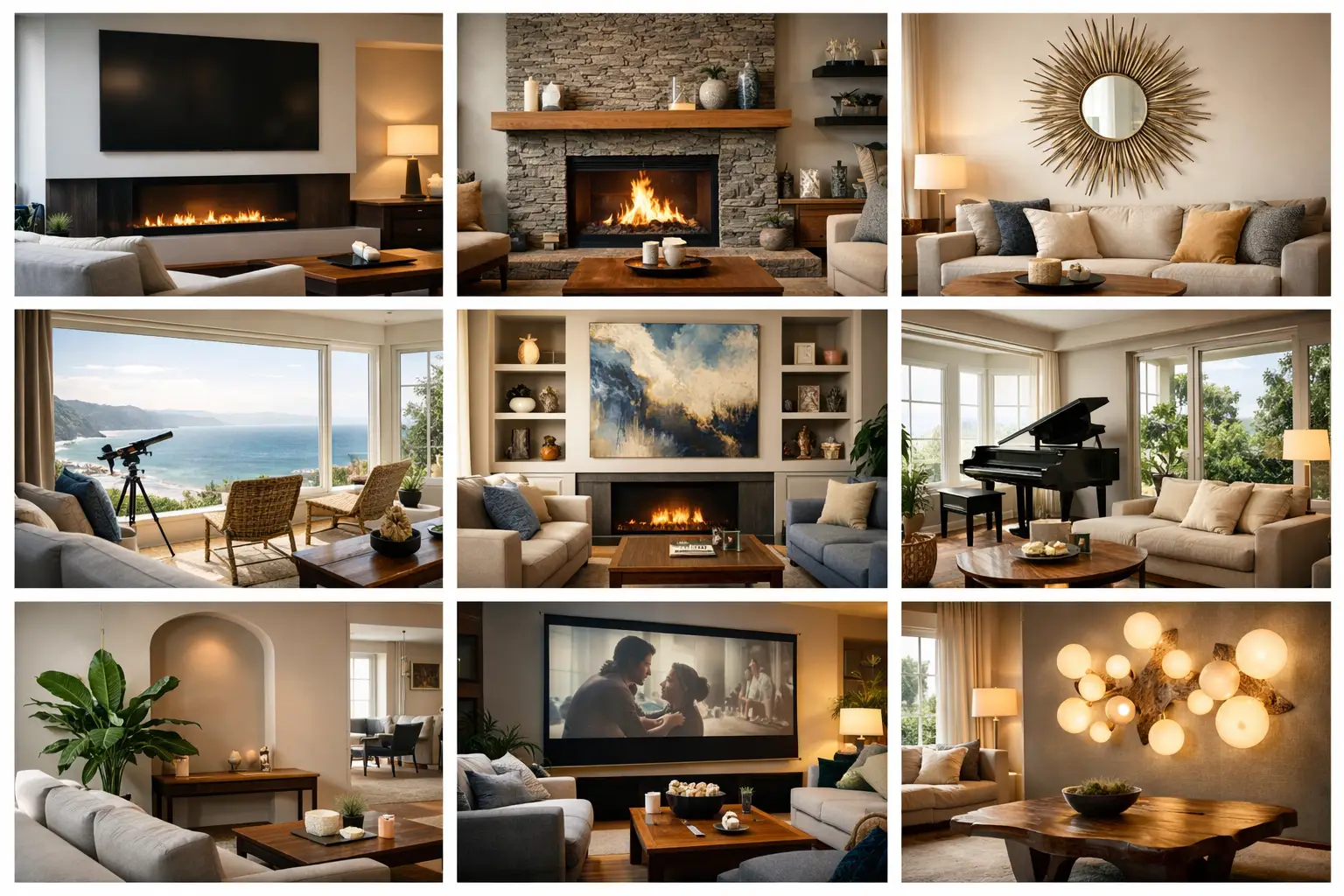
Some living rooms feel finished the moment you walk in. Others feel like a collection of nice things still waiting for a point of view. That is usually the difference a focal point makes. The best living room focal point ideas do not just give the eye somewhere to land. They set the mood, organise the room, and make everything around them look more intentional.
If your space feels flat, safe, or slightly undecided, the answer is rarely more accessories. It is usually one stronger move. A focal point gives the room hierarchy. It says this matters, look here first, and let everything else support it.
What makes a strong focal point in a living room?
A focal point is the element that holds the room. Sometimes it is architectural – a fireplace, a large window, a concrete wall, a built-in bookshelf. But plenty of modern homes and flats do not come with that kind of ready-made drama. In those spaces, the focal point has to be created.
Scale matters first. If the piece is too small, it will read as decoration rather than definition. Contrast matters next. A focal point needs enough difference in colour, shape, material, or light to stand apart from the rest of the room. Position matters too. If it is tucked into a corner or competing with three other statement moments, it loses force.
This is where people often get it wrong. They add a bold chair, a patterned rug, a shelf of objects, and a bright lamp, then wonder why nothing lands. A room does not need five heroes. It needs one lead and a supporting cast.
Living room focal point ideas that actually shift the room
1. Use oversized art as the anchor
If you want the fastest route to impact, start with art at architectural scale. Large-format artwork does more than fill an empty wall. It creates atmosphere, introduces colour with purpose, and gives the room an immediate centre of gravity.
This works particularly well in open-plan living areas or newer homes where the architecture is clean but visually quiet. A generously scaled artwork above a sofa or sideboard can give the room the confidence the bones do not. Go too small and it looks apologetic. Go large and the whole space sharpens.
Abstract works are especially effective when you want mood over narrative. They let colour and composition do the heavy lifting. If your room is mostly tonal, art can be the element that breaks the beige spell without tipping into chaos.
2. Build the room around a sculptural light
Lighting is often treated as the practical layer. It should not be. A sculptural pendant, oversized floor lamp, or dramatic wall light can become the focal point in its own right, especially in rooms where wall space is limited.
This approach works well when you want a focal point that feels lighter than a large furniture piece. It draws the eye upward, helps balance low-profile seating, and changes the room both day and night. In the evening, it becomes part object, part atmosphere.
The trade-off is visibility. A statement light needs space around it to be read properly. If the ceiling is low or the room is already visually busy, it can feel cramped rather than considered. In that case, one strong floor lamp with a sculptural silhouette may do the job better than a pendant fighting for air.
3. Create a colour block wall with intent
Not every focal point needs to be an object. Sometimes the strongest move is architectural colour. A painted wall in a saturated tone can frame a sofa, artwork, or shelving unit and instantly create hierarchy.
The key word is saturated. Weak colour choices disappear. If you are going to commit wall space to a focal point, give it enough depth to change the energy of the room. Think olive, rust, cobalt, oxblood, or a sharp chalky green rather than a hesitant greige with aspirations.
This option is useful if you want impact on a tighter budget, but it depends on the room’s light. South-facing spaces can flatten cooler tones, while bright natural light can make warm shades sing. Test first. Paint is cheaper than art, but repainting a bad decision is still annoying.
4. Let the sofa lead
In some living rooms, the best focal point is the largest object already in play. A sofa in a rich colour or striking shape can lead the composition if the rest of the room is edited carefully around it.
This is less about novelty and more about presence. A deep rust sectional, a curved velvet sofa, or a modular piece with real volume can set the tone for the entire room. Everything else then supports it through texture, contrast, and restraint.
The risk is getting stuck with a major purchase that feels too trend-led after a year or two. If you are using the sofa as the focal point, choose a shape with longevity and let the bolder expression come through upholstery, cushions, and surrounding objects.
5. Turn the fireplace into something worth looking at
A fireplace is often treated as the automatic focal point. Fair enough – it usually sits in the centre of the room and has architectural weight. But not all fireplaces deserve the attention they get.
If yours feels dated, undersized, or disconnected from the rest of the room, treat it as a base rather than a finished feature. Paint the surround, reclad it, add oversized art above it, or flank it with pieces that give it context. The point is not to decorate the mantel into submission. It is to make the entire composition feel deliberate.
This matters in many villa renovations and transitional homes, where original features can either add character or drag the room backwards. Keep the bones if they are good. Update the framing if they are not.
6. Use a statement rug to ground the space
A rug can absolutely be a focal point, but only if it has enough scale and conviction. A small rug floating under the coffee table is not a focal point. It is a missed opportunity.
A large rug with bold pattern, unusual colour, or graphic geometry can organise the seating area and give the room a strong visual core. This is especially effective in spaces with simple walls and low furniture, where the eye needs something to hold onto at ground level.
Patterned rugs are useful if you want movement, but they need balance. If the art, cushions and objects are already competing, a loud rug can tip the room into visual noise. The room still needs one clear lead.
How to choose the right focal point for your space
The smartest living room focal point ideas respond to the room you actually have, not the one saved in your camera roll. Start with what the architecture is doing. If there is a beautiful window, a timber ceiling, or a sharp built-in element, emphasise it rather than fighting it.
Then look at the room’s weak point. Is it too beige? Too low? Too scattered? Too polite? Your focal point should solve that problem. Large art adds emotion and structure. Sculptural lighting adds height and atmosphere. Colour creates energy. A strong sofa gives weight and identity.
Also think about sightlines. What do you see first when you enter the room? What sits behind the sofa? What anchors the main seating zone? The focal point should be visible enough to orient the space, not hidden in a corner waiting to be appreciated from one specific angle.
Supporting the focal point without watering it down
Once you have your focal point, resist the urge to keep pushing. This is where many rooms lose clarity. A strong focal point needs support, not competition.
Repeat one or two elements from it elsewhere in the room. If the artwork carries deep blue and terracotta, echo those tones in a cushion or object. If the statement piece has a curved form, bring in softer shapes through a side table or lamp. That creates rhythm without turning the room into a matching set.
Negative space matters too. Leave breathing room around the main feature so it can actually be read. Not every surface needs styling. Not every wall needs filling. A room with one confident focal point and enough quiet around it feels sharper than a room packed with expensive distractions.
For design-aware homes, this is usually the shift that changes everything. Less filler. More intent. One defining piece, properly placed, can do more for a living room than a month of hesitant accessorising.
If your room still feels unfinished, do not ask what else it needs. Ask what deserves to lead.