

TL;DR:
- Layered lighting combines ambient, task, and accent sources to create depth and visual interest.
- Proper planning and testing optimize mood, highlight decor, and increase energy efficiency.
- Small adjustments in fixture placement, height, and bulb temperature significantly enhance room ambiance.
Most homes in New Zealand are lit by a single overhead fixture, and that one source does a surprisingly poor job of making a space feel alive. The result is a room that looks flat in photos, feels uncomfortable at night, and fails to show off the furniture and art you’ve carefully chosen. Layered lighting fixes all of that. By combining multiple light sources at different heights and intensities, you can shift the mood of any room in minutes, highlight your best decor, and create an interior that feels genuinely considered. This guide walks you through every step, from understanding the basics to testing your final setup.
Table of Contents
- Why layering lighting matters in modern interiors
- The essential tools and prep for successful lighting layers
- Step-by-step guide to layering lighting at home
- Verifying your results and avoiding common mistakes
- Our take: Why most homes stop at step one (and how to break out)
- Elevate your home with inspired lighting solutions
- Frequently asked questions
Key Takeaways
| Point | Details |
|---|---|
| Layered lighting basics | Combine ambient, task, and accent lights to enhance style and functionality in any room. |
| Plan before you buy | Assess your space and gather fixtures and tools upfront for a smooth installation. |
| Step-by-step execution | Follow a simple sequence—ambient first, then task, then accent—for best results. |
| Test and adjust | Try different setups and make tweaks to avoid harshness and perfect your look. |
Why layering lighting matters in modern interiors
A single overhead bulb treats every corner of a room the same way, flooding the space with uniform brightness that flattens texture, washes out color, and removes any sense of depth. Layered lighting works differently. It uses multiple sources, each with a distinct purpose, to build an interior that feels both functional and visually rich.
The three core types are ambient, task, and accent lighting. Ambient light is your base layer, the general illumination that fills a room. Task lighting focuses on specific work areas like a reading chair or kitchen counter. Accent lighting is the most expressive layer, used to highlight artwork, shelving, or architectural features. Together, they create a room that responds to how you actually live in it.
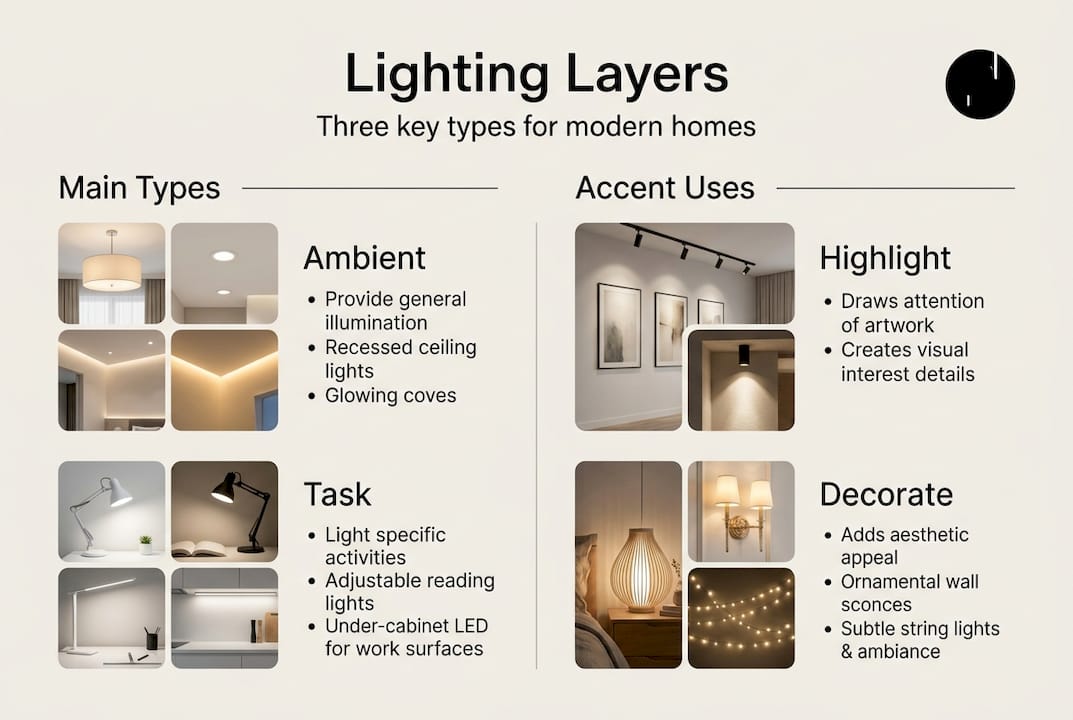
As we’ve noted before, layered lighting creates depth and balances functionality with visual appeal. That balance is what separates a room that looks designed from one that simply looks occupied.
The contrast with single-source lighting is immediate. A bare ceiling light can make a living room feel like a waiting room. Add a floor lamp behind a sofa, a small table lamp near a bookshelf, and a focused beam on a piece of wall art, and the same room suddenly has warmth, dimension, and personality.
Here’s why homeowners who make the switch rarely go back:
- Highlights your decor: Accent lighting draws the eye to art, plants, and sculptural objects you’ve already invested in
- Flexible ambiance: Dimmers and multiple circuits let you shift from bright and energetic to soft and relaxed in seconds
- Improved comfort: Reducing glare and harsh overhead light eases eye strain, especially in the evenings
- Energy efficiency: Smaller, targeted fixtures use less power than running a single high-wattage overhead all night
- Better photography: Layered rooms photograph beautifully, which matters when you want to capture your space
“A well-lit room isn’t about brightness. It’s about knowing where the light lands and what it reveals.”
Understanding how to approach layering home decor and lighting together is one of the fastest ways to elevate a space without buying new furniture. And when you pair that with statement lighting tips, even a modest room can hold real presence.
The essential tools and prep for successful lighting layers
Good preparation saves you from mid-project frustration. Before you start moving fixtures or buying bulbs, take stock of what your room actually needs.

The right lighting selection depends on your room’s layout, function, and desired vibe. A long open-plan living area needs a different approach than a compact bedroom or a home office. Knowing your room’s purpose before you shop prevents costly mismatches.
Here’s a quick reference for what you’ll need:
| Item | Purpose |
|---|---|
| Ambient fixture (ceiling or pendant) | Provides base-level general illumination |
| Accent lamp or wall sconce | Highlights art, shelving, or focal points |
| Task light (desk or reading lamp) | Focused light for work or reading areas |
| Dimmer switch or smart plug | Controls intensity for flexible ambiance |
| Measuring tape | Ensures correct fixture height and spacing |
| Extension cord or power board | Supports plug-in fixtures without rewiring |
| Warm white LED bulbs (2700K to 3000K) | Creates a soft, inviting tone across all layers |
Before installing anything, check your existing wiring and ceiling fixtures. If you’re unsure, consult a licensed electrician. Safety always comes first, especially when adding new ceiling-mounted fixtures.
Pro Tip: If you’re renting or want flexibility, plug-in pendant lights and cordless LED lamps are excellent options. They require zero installation and can be repositioned as your layout evolves. Browse bright room ideas for inspiration on how plug-in setups can look just as polished as hardwired ones.
Avoid these common prep mistakes:
- Skipping measurements: A lamp that’s too tall or a pendant hung too low disrupts the whole visual balance
- Mixing color temperatures: Combining a cool white bulb (5000K) with warm ones (2700K) creates an unsettling, mismatched glow
- Over-lighting small spaces: More fixtures don’t always mean better results. In a small room, two well-placed lamps beat five poorly positioned ones
- Ignoring existing natural light: Your layering plan should account for how sunlight moves through the room during the day
- Buying fixtures before measuring: Always measure ceiling height, wall space, and furniture placement before purchasing
When you’re choosing statement lighting for a larger area, think about visual zones. Each zone can have its own lighting personality while still feeling cohesive.
Step-by-step guide to layering lighting at home
With your tools ready and your room assessed, here’s how to build your layers from the ground up.
- Assess your space and needs. Walk through the room at different times of day. Note where natural light falls short, where you do focused work, and which features you want to highlight. Write it down.
- Install your ambient layer first. This is your ceiling light, pendant, or flush-mount fixture. It sets the overall brightness level. Make sure it’s on a dimmer so you can lower it when the other layers come on.
- Add task lighting. Position a desk lamp, reading lamp, or under-cabinet light wherever you need focused illumination. Task lights should be bright enough to work by without spilling harsh light into the rest of the room.
- Layer in accent lighting. Use a directional floor lamp, a small table lamp, or a wall sconce to highlight a piece of art, a bookshelf, or a plant. This is the layer that adds character.
- Test and adjust. Turn on all three layers together and evaluate. Then switch off the ambient light and see how the room feels with just task and accent. Adjust heights, angles, and bulb brightness until the balance feels right.
As a general principle, start with ambient lighting, then add task and accent layers for best results. Skipping straight to accent lighting without a solid ambient base leaves the room feeling patchy.
| Lighting type | Fixed installation | Portable option |
|---|---|---|
| Ambient | Ceiling pendant, recessed lights | Floor lamp, large table lamp |
| Task | Under-cabinet strip, wall-mounted reading light | Desk lamp, clip-on light |
| Accent | Recessed spotlights, hardwired wall sconce | Plug-in sconce, small table lamp |
Fixed options offer a cleaner look and are ideal for permanent setups. Portable options give you flexibility and are perfect for renters or anyone who likes to rearrange.
Pro Tip: Layer your light at different heights. A ceiling pendant, a mid-height floor lamp, and a low table lamp create a vertical spread that makes any room feel more dynamic. When choosing a statement lamp, consider its height relative to your furniture, not just its visual style. And if you’re focused on creating a softer base, the best ambient table lamp can do more work than a ceiling fixture in many living spaces.
Verifying your results and avoiding common mistakes
Once your layers are in place, the real work begins: evaluating what you’ve built and refining it over time.
Test your room at multiple times of day. Morning light, afternoon sun, and evening darkness all reveal different things about your setup. A layer that looks balanced at noon might feel too bright or too dim after sunset. Testing different arrangements and intensities enhances both style and comfort, so don’t treat your first arrangement as final.
Watch out for these common pitfalls:
- Over-lighting the room: If every lamp is on full brightness, the layered effect disappears. Use dimmers and choose lower-wattage bulbs for accent fixtures
- Harsh direct glare: Bare bulbs or downward-facing fixtures without shades create uncomfortable hotspots. Use diffusers, shades, or indirect angles
- Ignoring dimmers: A room without dimmers is a room with only one mood. Dimmers are the single most impactful upgrade you can make
- Flat height distribution: All lamps at the same height create a monotonous effect. Vary your placement from floor level to eye height to ceiling
- Neglecting the ceiling: Uplighting from a floor lamp or a wall sconce bouncing light upward adds volume to a room and makes ceilings feel higher
If something feels off, start by swapping bulbs before repositioning fixtures. A warmer bulb (2700K) in an accent lamp can completely change the mood without moving anything. Explore how using color with lighting can amplify the effect of your layers, especially when your walls or furniture carry strong tones.
“Getting your lighting right isn’t a one-day project. It’s a process of observation, small adjustments, and trusting what you see.”
Give yourself permission to tweak. The best-lit rooms are the ones that have been lived in and adjusted over time.
Our take: Why most homes stop at step one (and how to break out)
Here’s something we’ve noticed: most New Zealand homes have a pendant light, a floor lamp in the corner, and nothing else. Not because the homeowners don’t care about their space, but because the next step feels uncertain. What do you add? Where does it go? Will it look too busy?
The truth is, the fear of overdoing it keeps most people underdoing it. And a room with too little light is far more common than one with too much.
The shift happens when you stop thinking about lighting as a utility and start treating it as part of your decor. A lamp isn’t just a light source. It’s a sculptural object, a mood setter, and a focal point. When you see it that way, adding a second or third layer stops feeling like a technical decision and starts feeling like styling.
We’ve seen real mood change with lighting happen in rooms that changed nothing else. No new furniture, no paint, no renovation. Just thoughtful light placement. Start with one new lamp. Put it somewhere unexpected. See what it does to the room. That’s usually all it takes to get hooked on the process.
Every home is different, and your lighting should reflect how you actually use your space, not how a showroom tells you to.
Elevate your home with inspired lighting solutions
Layered lighting is one of the most rewarding upgrades you can make to a home, and having the right fixtures makes it far easier to pull off with confidence. At Lifted+, we curate lighting for New Zealand homes that balances sculptural form with real-world function, so every piece you add works both as a light source and as a design statement.

Whether you’re building your first layered setup or refining an existing one, our lighting mood ideas and editorial guides give you the visual direction to move forward with clarity. Browse our full range and find pieces that suit your space, your palette, and your lifestyle when you shop for lighting at Lifted+. Your next layer is closer than you think.
Frequently asked questions
What are the three main types of lighting for layering?
Ambient, task, and accent lighting are the essential types for an effective layered lighting plan. Each serves a distinct purpose and works best when used together.
How do I choose lighting fixtures that suit my home’s style?
Pick fixtures that match your room’s color palette and architecture, balancing statement pieces with subtle options. Lighting selection should reflect both function and the atmosphere you want to create.
Can I layer lighting in a rental without rewiring?
Yes, portable lamps, battery-powered LEDs, and adhesive strip lights enable easy layering with no permanent changes. Plug-in options work especially well in rentals or flexible living spaces.
How can I avoid harsh lighting?
Use dimmers, soft white bulbs, and indirect fixtures to create a pleasant glow and reduce glare. Testing different intensities and arrangements is the most reliable way to find what feels comfortable.
What’s a quick way to make a room feel cozier with light?
Add a table lamp with a warm bulb and position it near seating or art to instantly boost ambiance. Accent lighting highlights features and improves comfort without requiring any major changes to your space.
Recommended
- How To Choose Statement Lighting For Open Plan Spaces – Lifted+ | More Colour. More Mood. More Life.
- Statement Lighting That Holds A Room – Lifted+ | More Colour. More Mood. More Life.
- Mood Lighting That Actually Changes A Room – Lifted+ | More Colour. More Mood. More Life.
- How To Choose The Best Ambient Table Lamp – Lifted+ | More Colour. More Mood. More Life.