
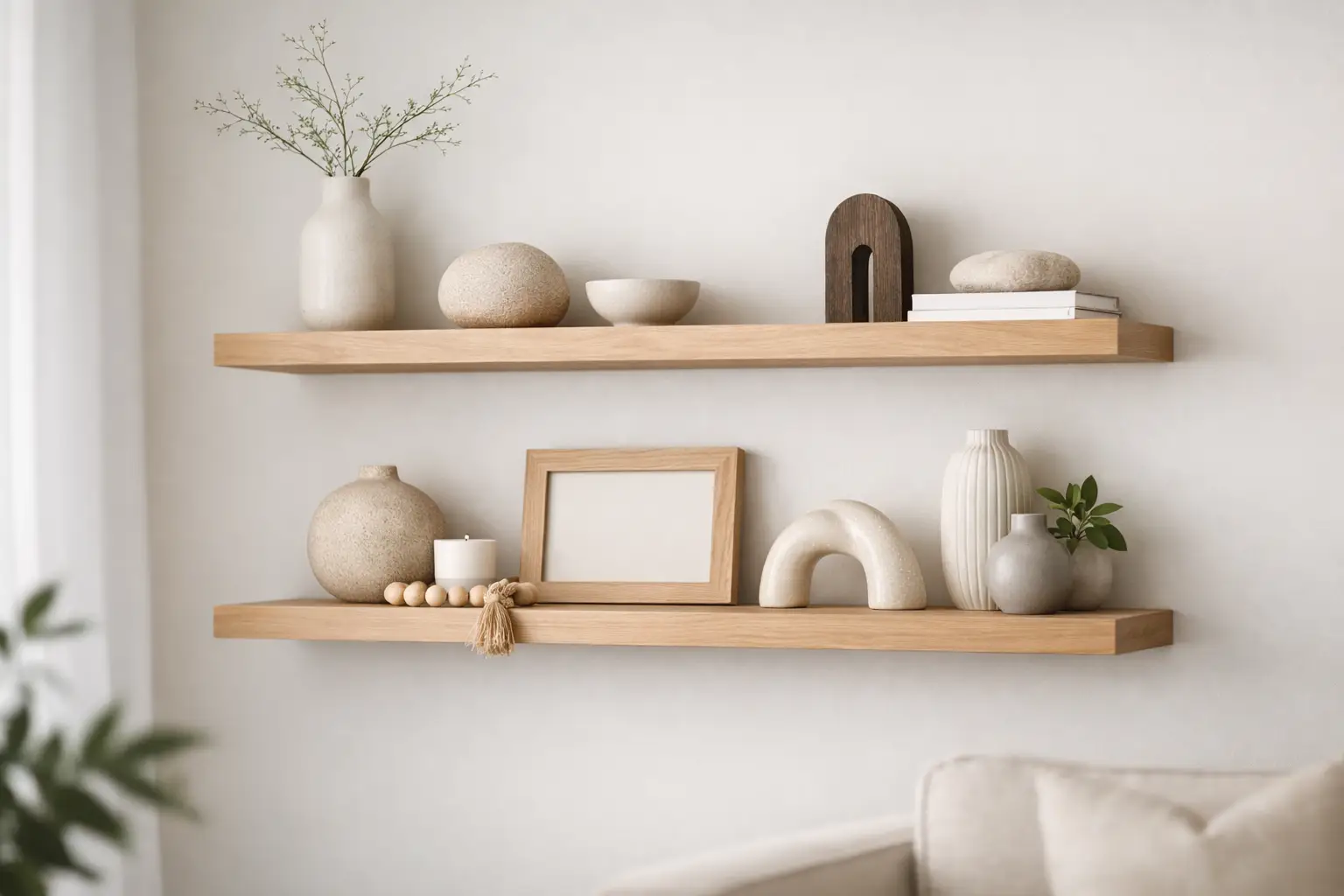
A shelf can ruin a room faster than almost anything else. Not because it is full, but because it is undecided. A few books, a candle, a tiny vase, a souvenir, another small object, then something woven for texture – suddenly the whole thing feels busy, apologetic, and strangely dull.
That is usually the real issue behind the search for how to style shelves without clutter. It is not about owning too much. It is about showing too many things at the same visual volume, with no hierarchy to hold the eye.
Good shelf styling is editing. Stronger shapes. Better spacing. More intention. Less filler.
Table of Contents
How to style shelves without clutter starts with subtraction
If your shelves already feel chaotic, do not start by buying new objects. Start by removing at least a third of what is there.
This part matters because clutter is rarely solved by rearranging the same number of pieces in slightly different positions. If every shelf is crowded, every object has to compete for attention. Nothing lands. The eye keeps moving, and the room loses calm.
Pull everything off or, if that feels dramatic, remove enough to create visible breathing room. Then look at what deserves to return. Keep the pieces with presence – objects with scale, sculptural form, rich colour, or personal relevance. Leave out anything that only exists to “fill a gap”. Gap-fillers are usually the first thing making shelves feel generic.
There is a trade-off here. Sparse shelves can feel flat if every item is timid. But fuller shelves are not the answer. Fewer, stronger pieces almost always create more impact.
Pick a point of view before you place a single object
The best shelves feel connected to the room around them. They do not look like a random holding zone for nice things.
Before you style, choose the visual direction. That might be led by colour, material, mood, or shape. If your room already has a strong artwork, a bold rug, or a sculptural lamp, let the shelves speak to that. Repeat a tone. Echo a curve. Carry through a material. This creates cohesion without making everything too matched.
For a colour-forward interior, shelves are a chance to reinforce mood. A hit of lacquered red, a smoky glass object, an inky ceramic vessel, a stack of books with acid-bright spines – these choices feel considered when they relate to the room’s palette. Colour should not be sprinkled on as decoration. It should help hold the composition together.
If your space is quieter, restraint still needs intention. Black, timber, off-white, stone, and olive can work beautifully, but only when the mix feels purposeful rather than safe.
Limit the palette
One reason shelves tip into clutter is too many competing colours. That does not mean everything has to match. It means the palette needs discipline.
A useful rule is to work with two dominant colours, then a third accent if the room can carry it. Books often introduce extra colour naturally, so factor that in. If your shelves already include vivid book jackets, keep objects simpler. If the books are neutral, that is where a brighter object can do the work.
Use scale to create calm
Tiny objects are shelf-cluttering specialists. One small ceramic can look refined. Six small ceramics scattered across three shelves look like visual static.
Scale brings authority. Larger vases, deeper bowls, taller book stacks, and substantial art leaned against the back of a shelf all create a stronger read from across the room. They simplify the arrangement because they occupy space with confidence.
This is especially useful in newer homes and townhouses where open-plan rooms need elements that can visually anchor a wall. A shelf of miniature décor pieces tends to disappear into fuss. A few larger forms make the whole area feel more architectural.
When people ask how to style shelves without clutter, what they often need is not less styling, but bigger styling. Not oversized for the sake of it – just substantial enough to hold their own.
Mix heights, not just objects
A shelf where everything sits at the same height feels flat even if it is not crowded. Varying height creates rhythm.
Use a tall object near a stack of horizontal books. Lean a framed piece behind a lower vessel. Place a box on top of books to lift it. These shifts stop the shelf feeling like a line-up and give the composition movement.
Create negative space on purpose
Empty space is not unfinished. It is what makes the styled areas look intentional.
One of the easiest ways to make shelves feel cleaner is to stop trying to use every section evenly. Some shelves can hold more. Others should hold almost nothing. The contrast is what gives the arrangement shape.
If you have built-ins or open shelving across a large wall, avoid repeating the same formula in every cubby. That kind of symmetry can look neat at first, but often feels stiff and over-styled. A better approach is to let one area carry visual weight while another stays open.
Think of negative space as part of the composition, not the leftover bit around it. It gives objects room to breathe and makes statement pieces look more expensive.
Books should anchor the arrangement, not drown it
Books are one of the easiest shelf-styling tools because they add height, colour, and personality. But too many books packed upright can quickly shift from design feature to storage problem.
Use books selectively. A short run of upright titles with bookends can work well, especially if the spines contribute to the palette. Horizontal stacks are often better for creating low platforms that support an object above. They break up the shelf and stop it looking like a mini library.
Be honest about what belongs there. Not every paperback needs to be on display. Keep the art, design, fashion, travel, or monograph-style books that add visual depth, and store the rest elsewhere if possible.
This is one of those areas where function matters. In a living room, a shelf can be more styled. In a home office or snug, practicality might lead. The goal is not to erase use. It is to stop use from becoming visual noise.
Bring in art and objects with presence
The most memorable shelves usually include at least one piece that shifts them from styled to designed.
That could be a small artwork leaned casually at the back, a sculptural lamp, a bold ceramic, or an object with unusual geometry. These pieces create tension and character. They stop the shelf becoming a parade of predictable accessories.
If everything on your shelf is decorative in the same polite way, the result will still feel cluttered because the eye has nowhere to land. One standout piece can solve that.
This is where curation matters more than quantity. A well-chosen object that holds a shelf is worth more than five acceptable ones. It is the same thinking behind a strong room edit – focal point first, supporting pieces second.
At Lifted+, that design logic runs through the whole approach: choose pieces that hold a room, then let everything around them support the mood rather than compete with it.
How to style shelves without clutter in real homes
Not every shelf is purely decorative, and pretending otherwise is unhelpful. Real homes need storage. They also need personality.
If you have children, work-from-home gear, or shelves doing double duty in a smaller flat, aim for zones. One shelf can be practical with boxes or concealed storage. Another can be more expressive. Trying to make every shelf both beautiful and highly functional often leads to compromise that looks messy.
It also helps to keep like with like. Group ceramics together rather than scattering them. Keep books in one or two areas. Put practical items inside closed boxes in a material that suits the room. When objects share a category, the arrangement reads as deliberate rather than accidental.
And finally, resist the urge to keep tweaking. Shelf styling tends to fall apart when every new object gets added without anything leaving. The fix is simple: when something new comes in, something else comes out.
That is how shelves stay sharp. Not fuller. Better edited.
A good shelf should make the room feel clearer the moment you look at it. If it does that, you do not need more décor. You need the confidence to stop.