
You Pay to Live There. So Why Doesn’t It Feel Like Home?
Here is how to make a rental feel like home when you cannot—or do not want to—paint, drill or spend money on improvements you may have to leave behind.
Table of Contents
Every week, a large part of a renter’s income disappears into the cost of having somewhere to live.
In the year to April 2026, New Zealand’s estimated mean weekly rent was $565. That is $29,380 a year. In Auckland, the mean was $619 a week—or $32,188 a year—before power, internet, insurance or any of the other costs that make a home function.
And yet many renters still feel as though they are guests in the place they pay for.
They live surrounded by colours they did not choose, walls they are reluctant to touch and rooms designed to offend no one—but which do not particularly reflect anyone either.
Rent pays for the right to live somewhere. Too often, it does not feel as though it buys the freedom to make that place feel like yours.
I understand that feeling because I have lived it too.
This is not a problem I invented to justify a product. It is the problem that led me to question why renters have so few good options in the first place.
The strange in-between of renting
So when you move into you rental, it’s now your home, but it is also someone else’s property.
Those two truths sit awkwardly together.
You sleep there. You raise children there. You cook, work, recover, celebrate, argue and begin again there. Your ordinary life unfolds inside those rooms. But when you think about changing a wall colour, hanging something substantial or creating a feature that feels more like you, another voice joins the conversation:
Am I allowed to do this?
What if the landlord says no?
What if the adhesive marks the paint?
What if I lose part of my bond?
What if I spend the money and have to move six months later?
So many renters do nothing—not because they do not care about their home, but because the financial and emotional risk can outweigh the reward.
Temporary should not mean unimportant
There is a persistent idea that renters should wait.
Wait until they buy. Wait until they have permission. Wait until they know how long they will stay. Wait until it feels sensible to invest in the space.
But life is still happening while we wait.
Home ownership may be years away, may not be the goal, or may simply be unaffordable. In the 2023 Census, 565,974 New Zealand households were renting their home. Renting is not a brief holding pattern for everyone; it is a major and sometimes long-term form of housing.
A home does not become emotionally insignificant because the tenancy has an end date.
Research into home personalisation supports something many of us already understand instinctively: being able to shape our surroundings can contribute to residential satisfaction, personal identity and a stronger sense of being at home. This is not about chasing a perfect Instagram room. It is about recognising yourself in the space where you live.
The hidden cost of making a rental feel better
Painting a room can look like an inexpensive weekend project. In a rental, it can become a much bigger commitment.
There is the paint, equipment and preparation. There may be the time spent requesting approval, moving furniture, applying multiple coats and cleaning up. Then there is the possible cost of returning the room to its original colour before moving out—effectively paying to decorate the same wall twice.
Fixtures and more permanent improvements create a similar problem. You may pay for them, install them and enjoy them, only to leave the benefit behind for the property owner. If they are removed, you may also be responsible for repairing any damage.
Under New Zealand tenancy guidance, tenants must request consent before making changes to a rental property. Landlords cannot unreasonably refuse a change that legally qualifies as minor, but tenants must still make the request and receive permission before going ahead. Reasonable conditions can also be attached, including returning the property to substantially the same condition at the end of the tenancy.
That leaves renters calculating more than the price of the product. They are calculating risk, permission, effort, reversibility and whether the improvement can move with them.
The cost of changing nothing
Doing nothing avoids the risk, but it has a cost of its own.
It can feel like living indefinitely among someone else’s choices. It can make a home feel generic, unfinished or disconnected from the person living there. For people who use colour as a form of self-expression, an all-neutral interior can feel less like a blank canvas and more like a creative gag order.
That does not mean every renter wants a riot of colour. The point is choice.
Some people want one deep, grounding wall. Some want a warm and cocooning bedroom. Some need a visual backdrop that makes their workday feel more deliberate. Others want to change their colour scheme as often as they change their underwear. No judgement. A colour commitment should not require a lifelong vow.
When home is also where you work
For people who work from home, the emotional relationship with their space becomes even more important.
The spare bedroom may also be an office. The dining table may become a desk. In an apartment, the living room might need to function as workspace, meeting background, exercise area and place to switch off—all within a few metres.
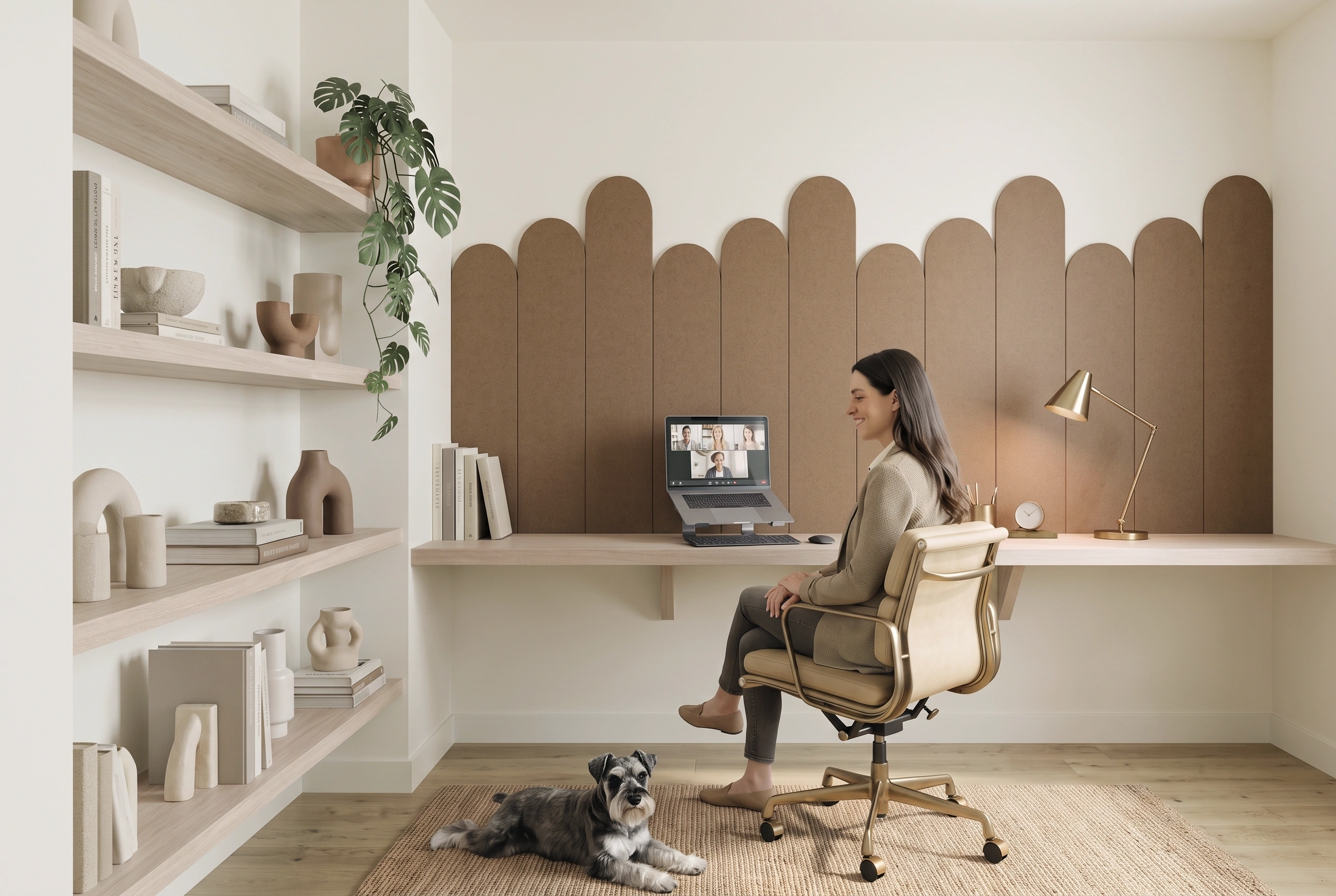
When work and home occupy the same room, visual cues can help create separation. A defined wall area can give a work zone its own identity, create a considered video-call background and signal a change of mode without building a physical wall or buying more furniture.
This is not only a renter problem. Homeowners may also avoid painting or wallpaper because of the cost, disruption, time or fear of choosing the wrong colour. A wall does not care whether you rent or own; it can still be expensive and annoying to redo.
Why apartments make every wall work harder
In a smaller home, every surface carries more visual weight. For anyone wondering how to make a rental feel like home in a compact apartment, the answer often begins with using the walls more intelligently—not adding more furniture.
There may be little room for extra furniture or floor-standing décor. Storage takes priority. A single wall may need to add warmth, personality and definition without consuming valuable floor space.
That makes walls one of the most useful—and underused—parts of an apartment. But conventional solutions often involve drilling, painting, wallpapering or committing to something made for that exact wall.
Renters and apartment dwellers do not need more décor that becomes a problem on moving day. They need design that understands movement, smaller spaces and changing lives from the beginning.
How to Make a Rental Feel Like Home Without Painting or Drilling
A useful solution should not simply carry the words “renter-friendly” on its packaging. It should reduce the practical barriers renters already face.
It should:
- add meaningful colour and character without requiring paint or drilling
- be straightforward to set up without specialist tools
- be designed for careful removal, with clear instructions and honest surface guidance
- minimise the work required to return the room to its previous state
- be able to move with the person who paid for it
- work in compact rooms where floor space is limited
- make good design easier for people who do not have the time or confidence to create a scheme from scratch
- allow a room to evolve when tastes, homes or life stages change
In other words, temporary décor should not feel disposable. It should be flexible, considered and worth taking with you.
So, is DwellForms™ the answer?
DwellForms™ is not the answer to every problem renters face.
It will not reduce the rent, improve security of tenure or fix a cold, damp home. Pretending otherwise would be marketing theatre, and renters deserve better than that.
What DwellForms™ can offer is an answer to one overlooked but deeply human problem: how to create colour, structure and a stronger sense of ownership in a home you do not own.
DwellForms™ is a collection of modular, precision-cut PET felt wall kits designed in New Zealand. The kits use considered shapes, proportions and layout guidance to create a finished feature without asking you to become an interior designer—or sacrifice a weekend to drop sheets and paint rollers.
They are designed to:
- create a substantial visual change without paint or drilling
- attach using purpose-selected adhesive pads rather than permanent fixings
- make a room feel more deliberate through colour, form and texture
- work vertically on the wall without taking up floor space
- be removed carefully and taken to a future home, subject to wall condition and correct setup and removal
- give non-decorators a curated starting point while still allowing creative people room to make the arrangement their own
Wall condition, paint quality and removal technique matter with any adhesive product. Tenancy agreements and landlord requirements matter too. We will never promise that every product is suitable for every wall, and we do not describe “renter-friendly” as permission to ignore your tenancy agreement. Clear testing, surface guidance and removal instructions are part of treating renters with respect.
For the serial redecorators: DwellForms™ makes change easier, but it does not make every colour change free. Panels can be moved or taken with you and fresh compatible adhesive pads used where appropriate. You may choose a new layout, move the feature to another room or introduce another colour over time. The goal is flexibility—not disposable decorating.


You should be able to see yourself in your home
Renters are often spoken about as if they are merely passing through.
But a rented home is not a waiting room
It is where real life happens, whether you stay for one year or ten. The people living there should have access to good design, meaningful colour and the freedom to feel emotionally at home—without turning every creative decision into a negotiation, a major project or a future repair bill.
That belief is at the heart of DwellForms™.
Not decorating for someone else’s property.
Creating something for your life—and taking it with you when life moves on.
Colour should not have to wait until you own the walls.
Join the first release
DwellForms™ is preparing for its first New Zealand release. Join the First-release list for product previews, colour reveals, setup guidance and early access when pre-sale opens.
Already staring at a wall that does not feel like you? Tell us about it—or send us a photo. Your room may help shape the renter resources, layouts and future colours we create next.

Michelle
Michelle Green is a co-founder of Lifted+ and creator of DwellForms™, a New Zealand-designed modular wall system developed from her own experience of wanting more colour, character and flexibility in homes she did not own.
This article provides general information only and is not legal advice. Tenancy agreements, wall surfaces and property requirements vary. Check your tenancy agreement and the latest Tenancy Services guidance before making changes to a rental property.