
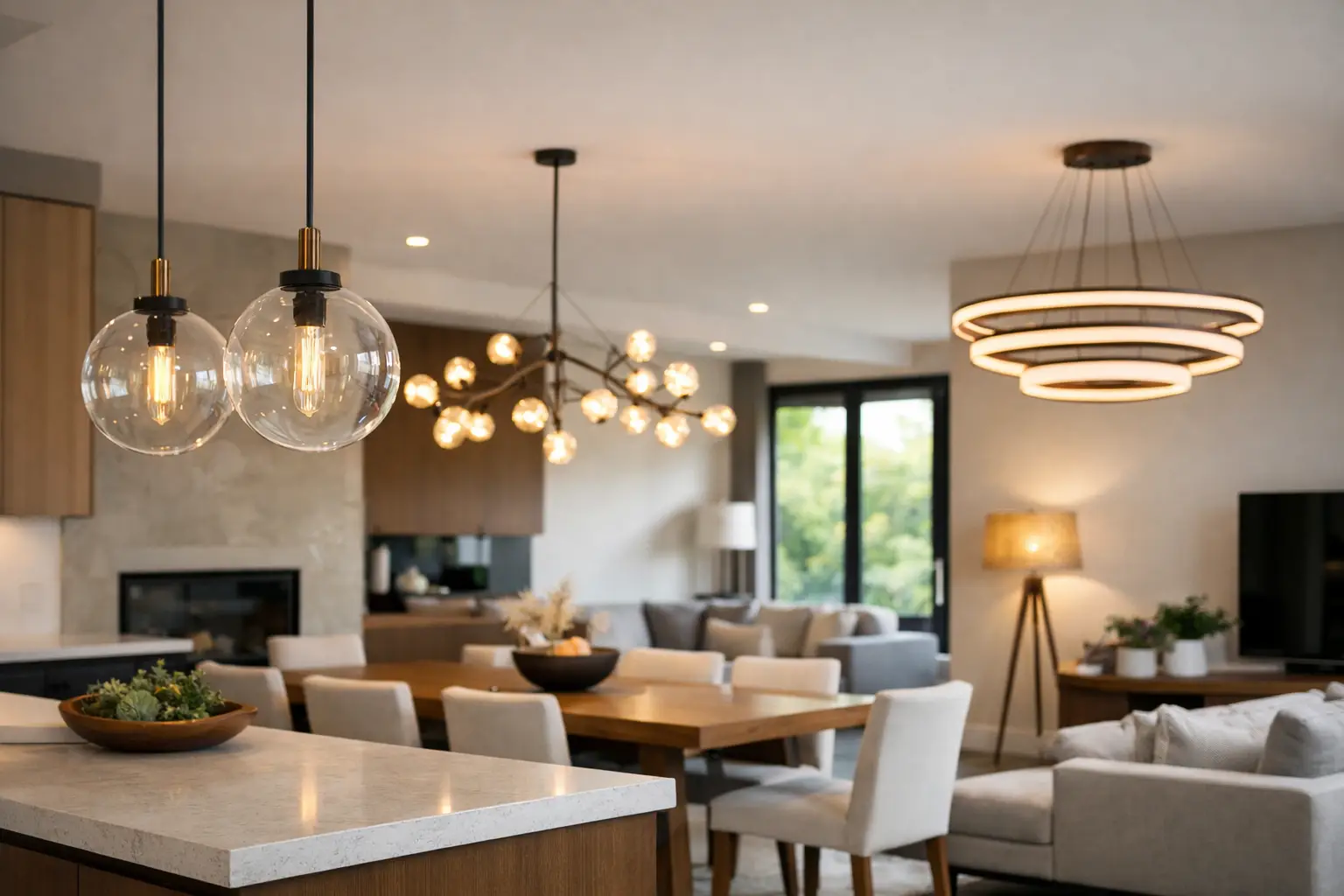
Open-plan rooms can look generous on a floor plan and strangely unresolved in real life. You’ve got the kitchen, dining area and living zone all sharing airspace, but not always sharing a point of view. That’s exactly why it pays to choose statement lighting for open plan spaces with intent. The right piece does more than brighten a room – it defines territory, shifts mood and gives the eye somewhere confident to land.
In a home without many walls, lighting becomes architecture. It can pull a dining setting into focus, add rhythm above an island, or stop a living area from drifting into visual nothingness. If your space feels a bit too safe, too flat or too dependent on downlights, statement lighting is usually the missing layer.
Table of Contents
Why statement lighting matters more in open-plan rooms
A closed room has built-in boundaries. An open-plan room doesn’t. That means your furniture, art, rugs and lighting all need to work harder to create shape and hierarchy.
Statement lighting is one of the fastest ways to do that because it occupies vertical space. It draws the eye upward, balances wide floor areas and gives each zone its own identity without breaking the room apart. A sculptural pendant over the dining table says this area is for gathering. A bold fixture over the island creates a practical work zone with presence. A softer but still expressive light in the living area can make that end of the room feel grounded rather than leftover.
This is also where people often get it wrong. They rely on a grid of ceiling spots, then wonder why the room feels more like a showroom than a home. Functional light matters, of course. But open-plan spaces need focal points as much as they need brightness.
Start with the zone, not the fitting
If you’re trying to choose statement lighting for open plan spaces, don’t begin by scrolling endless product pages and hoping a favourite jumps out. Start with the role the light needs to play.
In most open-plan layouts, there are two or three zones competing for attention. The dining area usually deserves the strongest decorative gesture because it has a fixed centre – the table. Kitchen islands come next, especially if they sit in direct sightlines from the entry or living room. Living areas are a little more nuanced. A pendant can work beautifully, but in some homes a sculptural floor lamp or oversized table lamp gives the better result because it keeps the ceiling from becoming overcrowded.
The question is not simply what looks good. It’s where the room needs definition. If one zone already has architectural drama, such as a bold splashback, oversized art or a richly coloured sofa, the lighting in that area may need to support rather than dominate. If another zone feels vague, lighting can become the anchor.
Scale is the part most people play too safe with
Open-plan rooms need lighting with enough physical presence to hold their own. Small pendants in large spaces rarely look refined. They usually look apologetic.
That doesn’t mean every fitting needs to be oversized, but it does mean proportion matters. Over a long dining table, a single tiny pendant will disappear. A cluster, a linear suspension, or one generously scaled form will make more sense. Over an island, the width and length of the bench should guide you. Two or three pendants can work well, but only if they have enough volume. Spindly fittings tend to vanish against a busy kitchen backdrop.
Ceiling height changes the equation. In many New Zealand homes, especially newer builds and renovated villas, open-plan areas can have strong volume. That’s an opportunity. Use it. A light with real drop and sculptural form can make the room feel intentional rather than merely large. If ceilings are lower, go broader instead of taller.
When in doubt, choose the piece that feels slightly bolder than your first instinct. Open spaces absorb drama. What feels big in a showroom often feels exactly right once it’s in the room.
Think in compositions, not single moments
The strongest open-plan interiors aren’t built around one heroic pendant and a collection of afterthoughts. They work because the lighting relates across the whole space.
That doesn’t mean every fitting has to match. In fact, matching everything can flatten a room fast. A better approach is to look for shared qualities: repeated curves, similar finishes, related colours, or a common visual weight. You want conversation, not uniform.
A smoked glass pendant above the dining table might sit beautifully with a sculptural wall light in the living zone and a compact coloured lamp on a console, provided the forms feel connected. This layered approach gives the space rhythm. It also stops the eye from reading one side of the room as finished and the other as ignored.
This is where curated interiors win. Too much choice usually leads to hesitation, then defaulting to safe options. A tighter point of view creates momentum. If the room already features expressive artwork, warm timber, lacquer, chrome or saturated upholstery, your lighting should join that language rather than politely stepping aside.
Colour belongs in lighting too
There’s no rule saying statement lighting has to be black, white or brass. In fact, open-plan spaces often benefit from a hit of colour overhead because it helps break up broad planes of joinery, plaster and glazing.
Blue, oxblood, glossy green, butter yellow, red-orange – these can all work if the colour is repeated somewhere else in the room. The key is intention. A coloured fitting should feel like part of the palette, not a random flourish.
If your home already leans expressive, lighting is a smart place to push further. Colour at ceiling level creates energy and surprise. It can also connect distant parts of an open plan room. A pendant that picks up tones from a large artwork or upholstered dining chairs makes the whole scheme feel more composed.
If you’re colour-curious but not fully committed, start with shape and material first, then introduce colour in a smaller fixture or lamp. You don’t need every piece shouting. One clear statement is often enough.
Material changes the mood
The material of a fitting affects how it feels when switched off just as much as how it glows at night. That matters in open-plan spaces because the light is on display all day.
Opaque shades create stronger form and more directional pools of light. Glass feels lighter and can help preserve sightlines, which is useful if the room already has a lot happening. Fabric or textured shades soften the atmosphere and take the edge off hard surfaces like stone, tile and polished concrete. Metal adds crispness and a more architectural note.
There’s a trade-off here. A highly sculptural opaque pendant may give you the strongest visual impact, but it could cast a narrower light spread. A clear or open form may illuminate better while making less of a statement in daylight. The right answer depends on whether your priority is mood, task lighting, or spatial definition. In most homes, you want a balance of all three.
Placement is where good choices become great ones
Even the best fitting will underperform if it’s hung in the wrong spot. In open-plan rooms, placement should follow furniture, not the room’s overall footprint.
Over a dining table, centre the light to the table itself, not the ceiling void. Over an island, align pendants with the bench, not with nearby cabinetry lines that happen to be convenient. In living areas, a pendant should relate to the coffee table or seating arrangement so it feels connected to how the room is actually used.
Height matters too. Hang a dining pendant low enough to create intimacy, but high enough to preserve sightlines across the table. Over an island, keep fittings clear of eye level when seated or standing nearby. If a piece is especially sculptural, give it room to be seen from multiple angles.
And don’t forget dimmers. Open-plan spaces host everything from weekday breakfasts to late dinners to quiet nights on the sofa. One lighting level won’t suit all of it. A statement fitting should be able to shift mood, not just stay bright.
When to hold back
Not every zone needs a headline act. If your dining pendant is dramatic and your walls feature large-scale art, the kitchen lighting may need to be cleaner and more restrained. If the architecture already carries strong lines, an overly busy fitting can create friction.
This is the difference between bold and overloaded. A room with conviction still needs editing. Give the eye moments to rest so the statement pieces actually read as statements.
If you’re unsure where to go strongest, choose one primary focal point and let the rest support it. That approach often creates a more expensive-looking interior than trying to make every light the star.
The best statement lighting doesn’t just fill a gap in the ceiling. It changes how the whole room feels. It gives open-plan living shape, confidence and atmosphere – exactly what these spaces need when beige restraint isn’t cutting it anymore. If a room feels like it’s waiting for permission to come alive, start overhead.